
Demonstrations over inflation and currency collapse have spread nationwide.
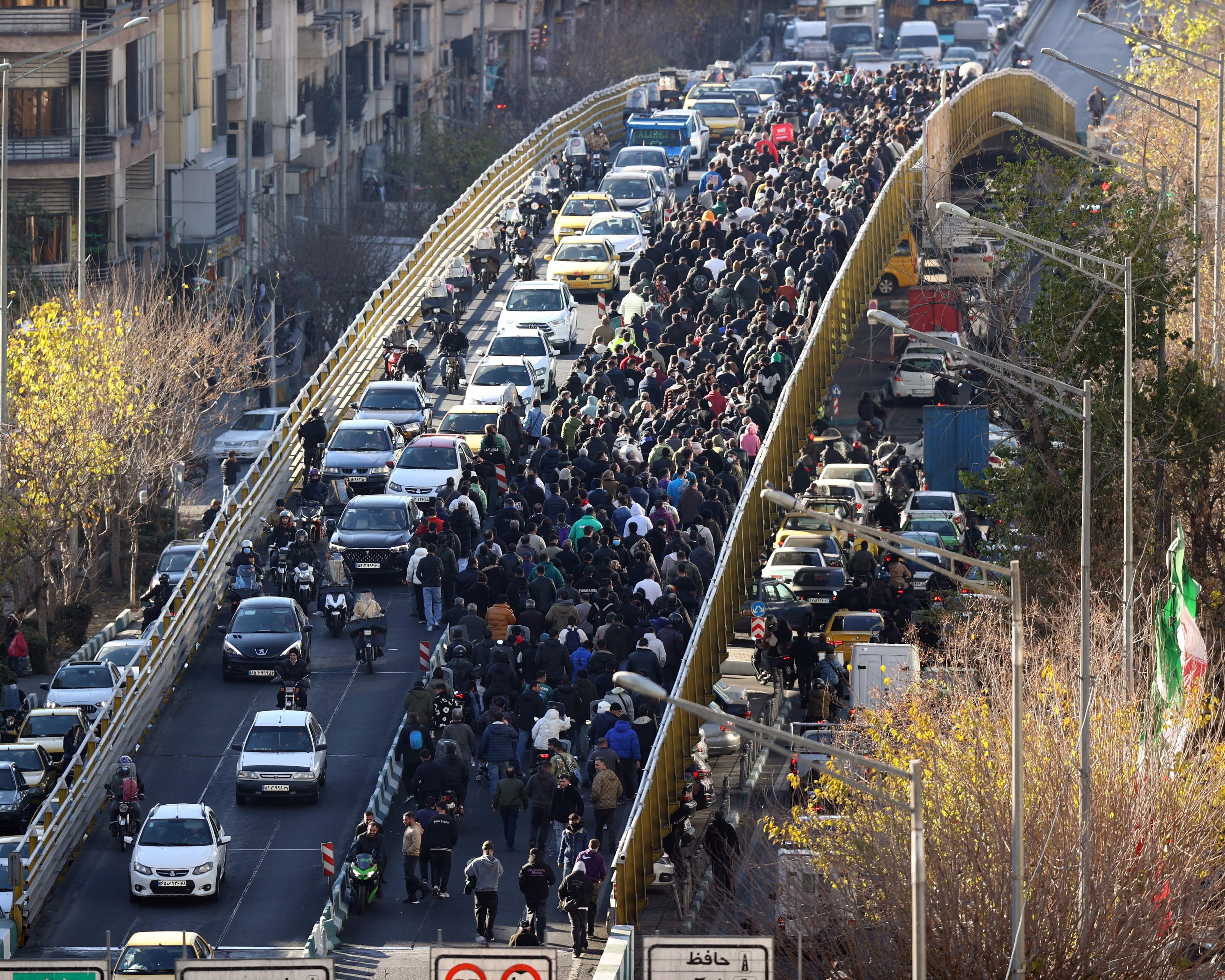
Since the start of the new year, Iran has been facing protests over inflation and alleged corruption within the government, becoming the largest demonstrations in the country since the death of 22-year-old Mahsa Amini in police custody in 2022 after being arrested for not wearing her hijab properly.
“In such a setting, when living costs rise, but incomes and job security don’t keep pace, livelihood grievances quickly turn into dissatisfaction,” said Kasra Qaredaghi, a Ph.D. student at the University of Central Florida, to DW.
“This economic crisis is unfolding in a context where public trust in the government’s ability to control inflation and create stability has eroded.”
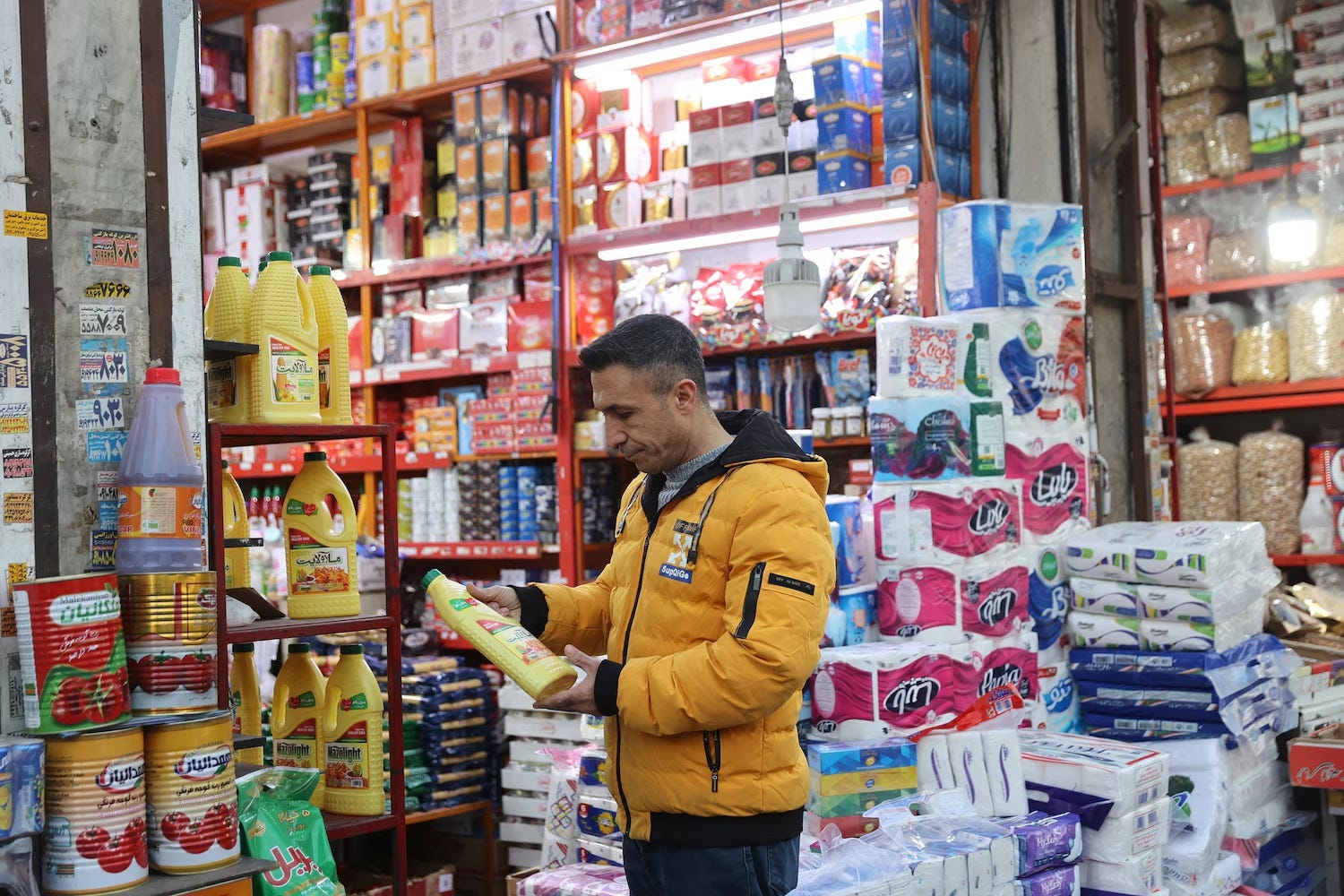
This comes as food prices rose 72% and health and medical services were up 50% from December 2024, as the Iranian rial reached an historic low, with renewed fears of conflict following previous reports from The Introspective detailing the 12-day war between Iran and Israel from June, and another Introspective report highlighting U.S. action in Venezuela, which led to the capture of Venezuelan President Nicolás Maduro.
“What will my children eat? Do we have to bring suitcases of cash to simply buy bread? Do you find that normal?” said Alborz, a merchant in Isfahan, to The Guardian.
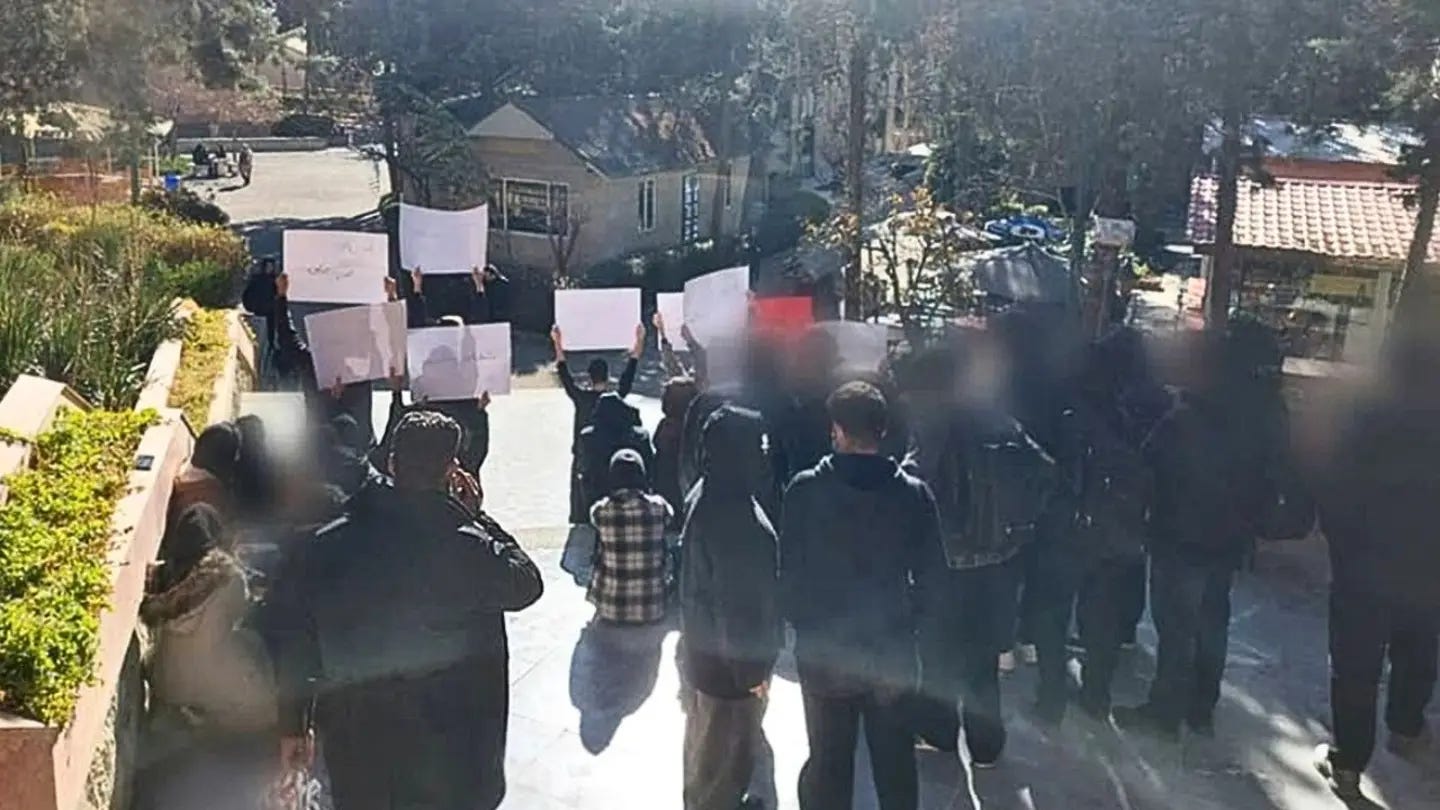
The protests later expanded to criticizing the government, with women’s rights activists and students carrying signs that read “death to the dictator” and “woman, life, freedom.”
“For years now, we have slowly but surely made significant changes to our lifestyles because of this corrupt government. This was the last nail in the coffin. We wanted this regime gone, and now there’s no way this regime will continue,” said Alborz.
A study from the Iran Human Rights (IHRNGO) group also found that executions across Iran rose in 2025, with at least 110 people executed by April 2025, 75% higher than the same period in 2024.
“The Islamic Republic’s extensive use of the death penalty has crossed all boundaries, turning executions into one of the most severe ongoing human rights crises in Iran,” said IHRNGO Director Mahmood Amiry-Moghaddam in a press release.
“The people, human rights organizations and the international community must find new strategies to confront the execution crisis in Iran.”
Government Response
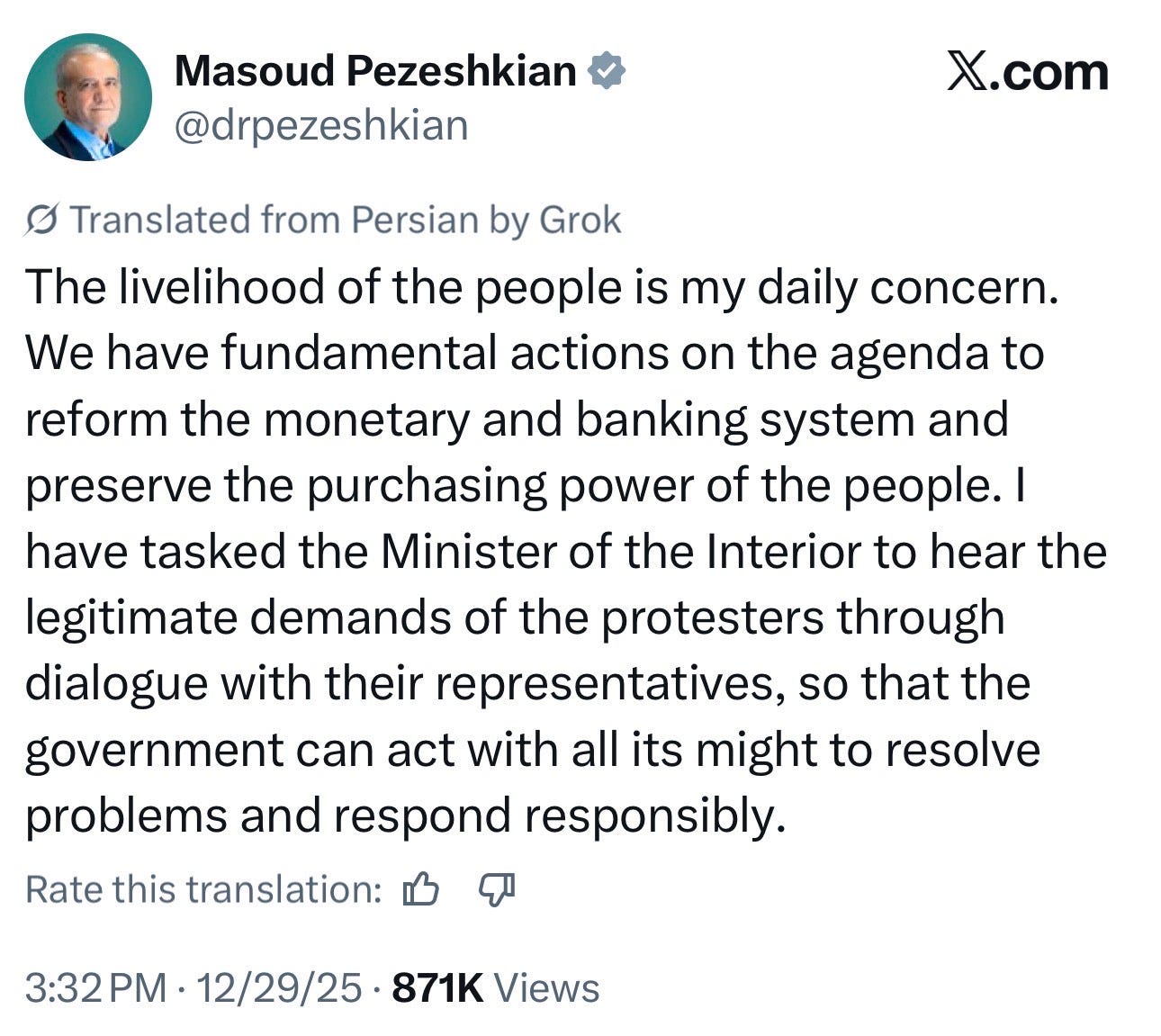
Iranian President Masoud Pezeshkian acknowledged the demands of the protesters in an X post, stating that his concern is with “the livelihood of the people.”
“We have fundamental actions on the agenda to reform the monetary and banking system and preserve the purchasing power of the people,” he wrote.
“I have instructed the minister of interior to hear their legitimate demands through dialogue with the representatives of the protesters so that the government can act responsibly and with all its might to resolve the problems.”
Iran’s Supreme Leader Ayatollah Ali Khamenei said the government is willing to “talk to the protesters” but said rioters “must be put in their place.”
“We talk to protesters. The officials must talk to them,” he said.
“But there is no benefit to talking to rioters. Rioters must be put in their place.”
He later claimed the protests were encouraged by Israel and the United States, despite providing no evidence.
“A bunch of people incited or hired by the enemy are getting behind the tradesmen and shopkeepers and chanting slogans against Islam, Iran and the Islamic Republic,” he said.
“This is what matters most.”
He then said the United States “must and will leave” the Middle East.
“With the determination of the region’s nations, America must and will leave this region,” he added.
This comes as research from the Human Rights Activists News Agency (HRANA) found that more than 1,200 people were arrested and that nearly 35 protesters have been killed in clashes with security forces, many of them teenagers.
“On the ninth day of nationwide protests, reports and videos received by HRANA continue to indicate the persistence of a heavy security atmosphere and the use of repressive measures by law enforcement and security forces to prevent the formation or expansion of protest gatherings,” the HRANA report said, noting that more than 78 people were arrested on the ninth day of demonstrations.
Those reported killed so far include:
- Amirhesam Khodayarifard, a 22-year-old from Kuhdasht.
- Dariush Ansari Bakhtiariwand, a 26- to 27-year-old from Fuladshahr.
- Khodadad Shirvani, a 32- to 33-year-old from Marvdasht.
- Shayan Asadollahi, a 27- to 28-year-old from Azna.
- Mostafa Fallahi, a 15-year-old from Azna.
- Vahab Mousavi, from Azna.
- Ahmad Jalil, a 21-year-old from Lordegan.
- Sajad Valamanesh, a 28-year-old from Lordegan.
- Ahmadreza Amani, a 28-year-old from Azna.
- Ahad Ebrahimpour Abdoli, a 35-year-old from Delfan County.
- Ali Azizi Jafarabadi, a 42-year-old from Harsin.
- Hossein Rabiei, from Qom.
- Mansour Mokhtari, from Marvdasht.
- Amirhossein Bayati, from Hamadan.
- Erfan Bozorgi, from Marvdasht.
- Amirmohammad Kouhkan, a 26-year-old from Neyriz.
- Taha Safari, a 15-year-old from Azna.
- Mehdi Emamipour, from Malekshahi County.
- Reza Azimzadeh, from Malekshahi County.
- Farez Aghamohammadi, from Malekshahi County.
- Mohammad Moghaddasi, from Malekshahi County.
- Ali Karimi Bavolaki, from Malekshahi County.
- Esmail Gharishvandi, from Izeh.
- Mohammad Qasem Rousta, from Marvdasht.
- Ali Golforoush, from Qom.
- Soroush Soleimani, from Lordegan.
- Saghar Etemadi, a 22-year-old from Farsan.
- Reza Kadyvrian, a 17-year-old from Kermanshah.
- Rasoul Kadyvrian, a 20-year-old from Kermanshah.
- Latif Karimi, from Malekshahi County.
- Reza Ghanbari, a 17-year-old from Kermanshah.
- Mohammad Nouri, a 17-year-old from Qom.
- Reza Moradi Abdolvand, an 18-year-old from Azna County.
- Sajad Babaei, from Qorveh.
International Reactions
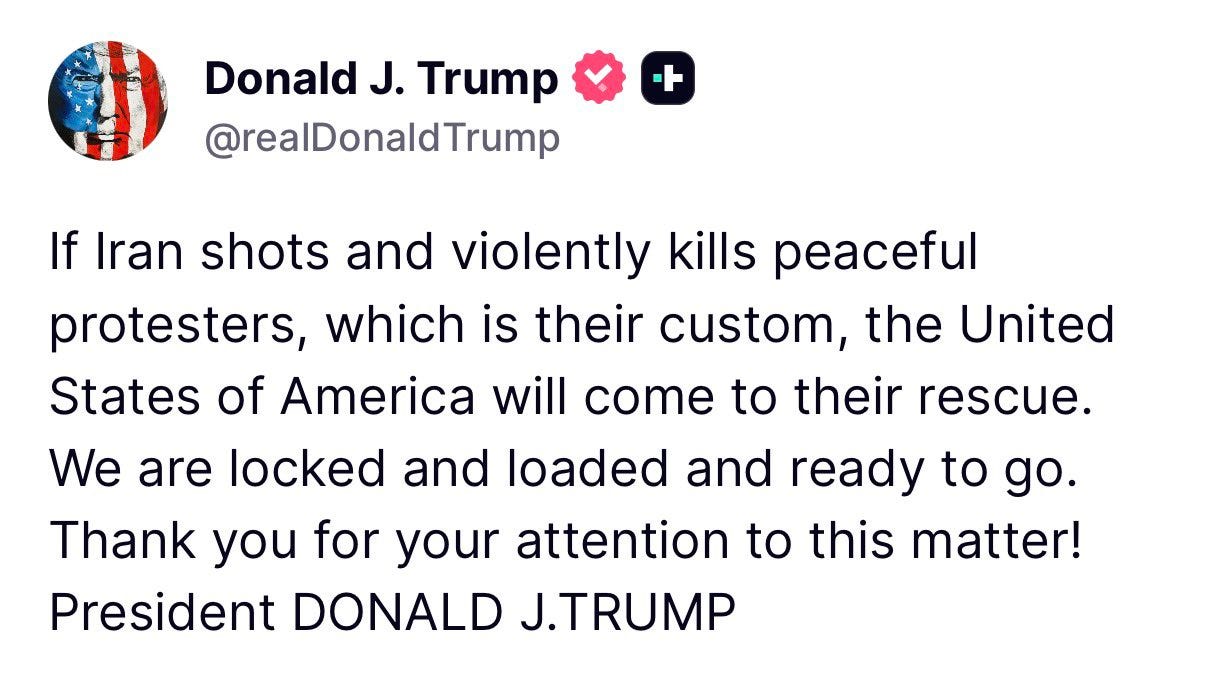
Within the United States, President Donald Trump previously threatened to intervene if protesters were killed during the demonstrations.
“If Iran shoots and violently kills peaceful protesters, which is their custom, the United States of America will come to their rescue. We are locked and loaded and ready to go,” he wrote on Truth Social.
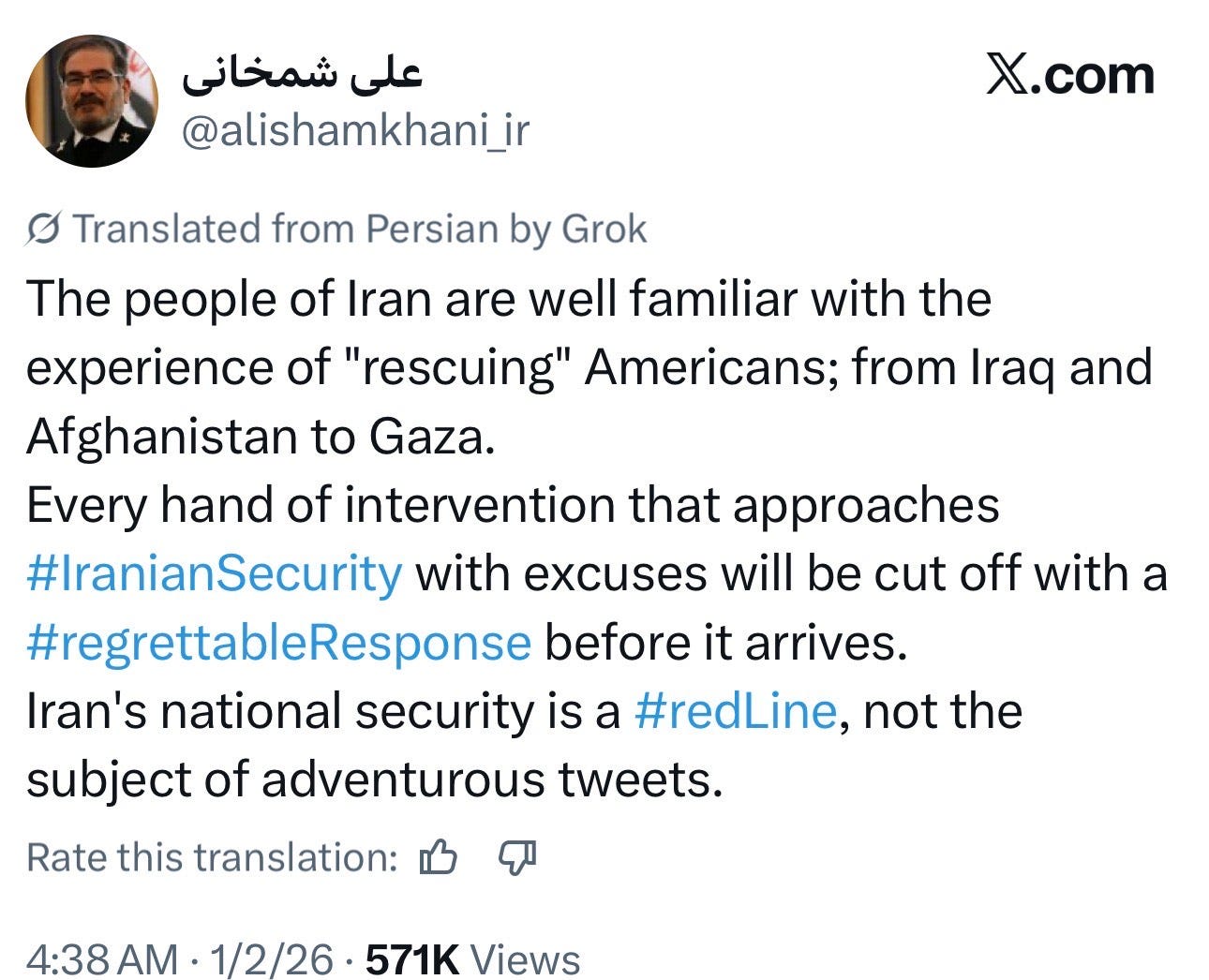
Ali Shamkhani, a political adviser to Iranian Supreme Leader Ayatollah Ali Khamenei, criticized Trump’s comments in an X post.
“The people of Iran are well acquainted with the experience of Americans coming to the rescue, from Iraq and Afghanistan to Gaza,” he wrote.
“Any hand of intervention that approaches Iranian security with pretexts will be severed by a regret-inducing response. Iran’s national security is a red line, not fodder for adventurist tweets.”
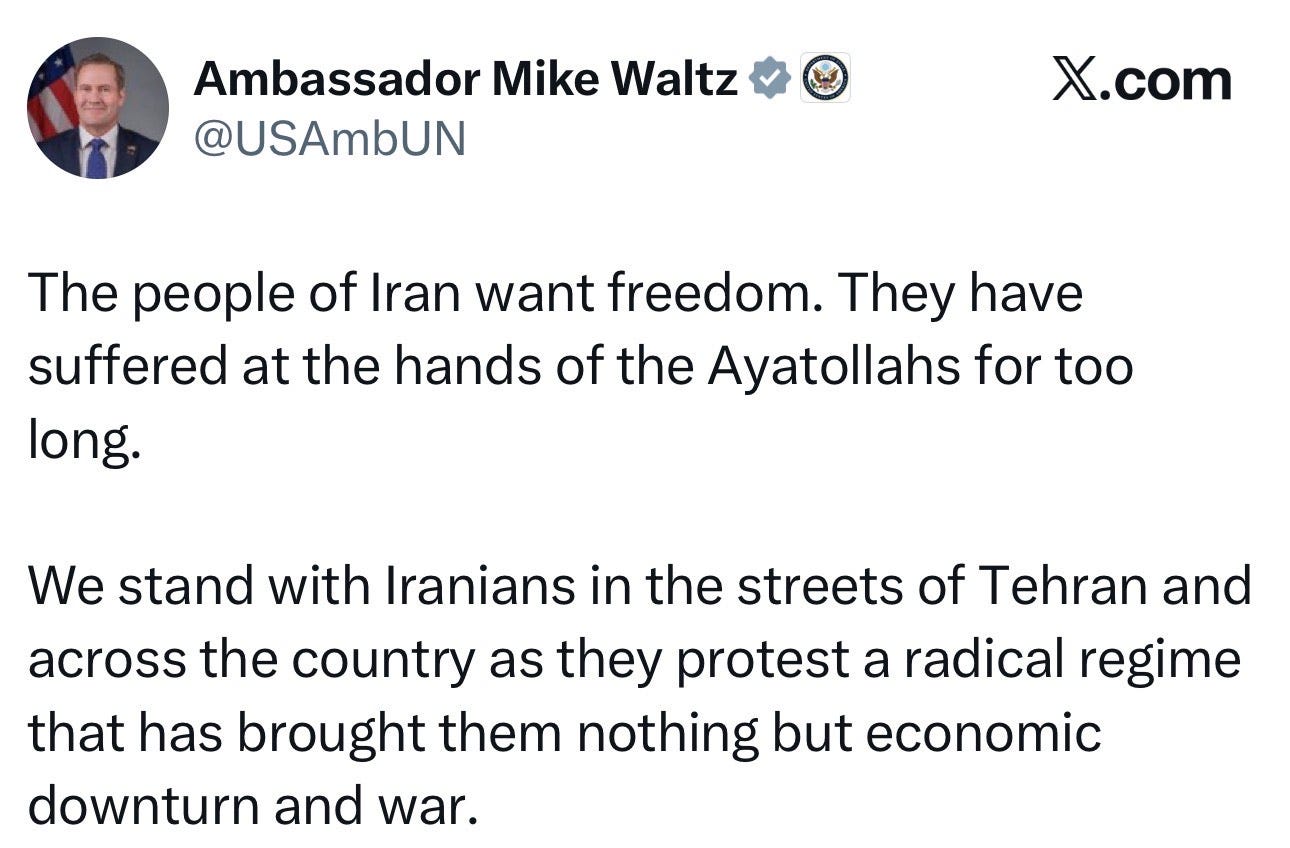
U.S. Ambassador to the United Nations Mike Waltz said the people of Iran wanted “freedom” and have “suffered at the hands of the ayatollahs for too long.”
“We stand with Iranians in the streets of Tehran and across the country as they protest a radical regime that has brought them nothing but economic downturn and war,” he wrote on X.
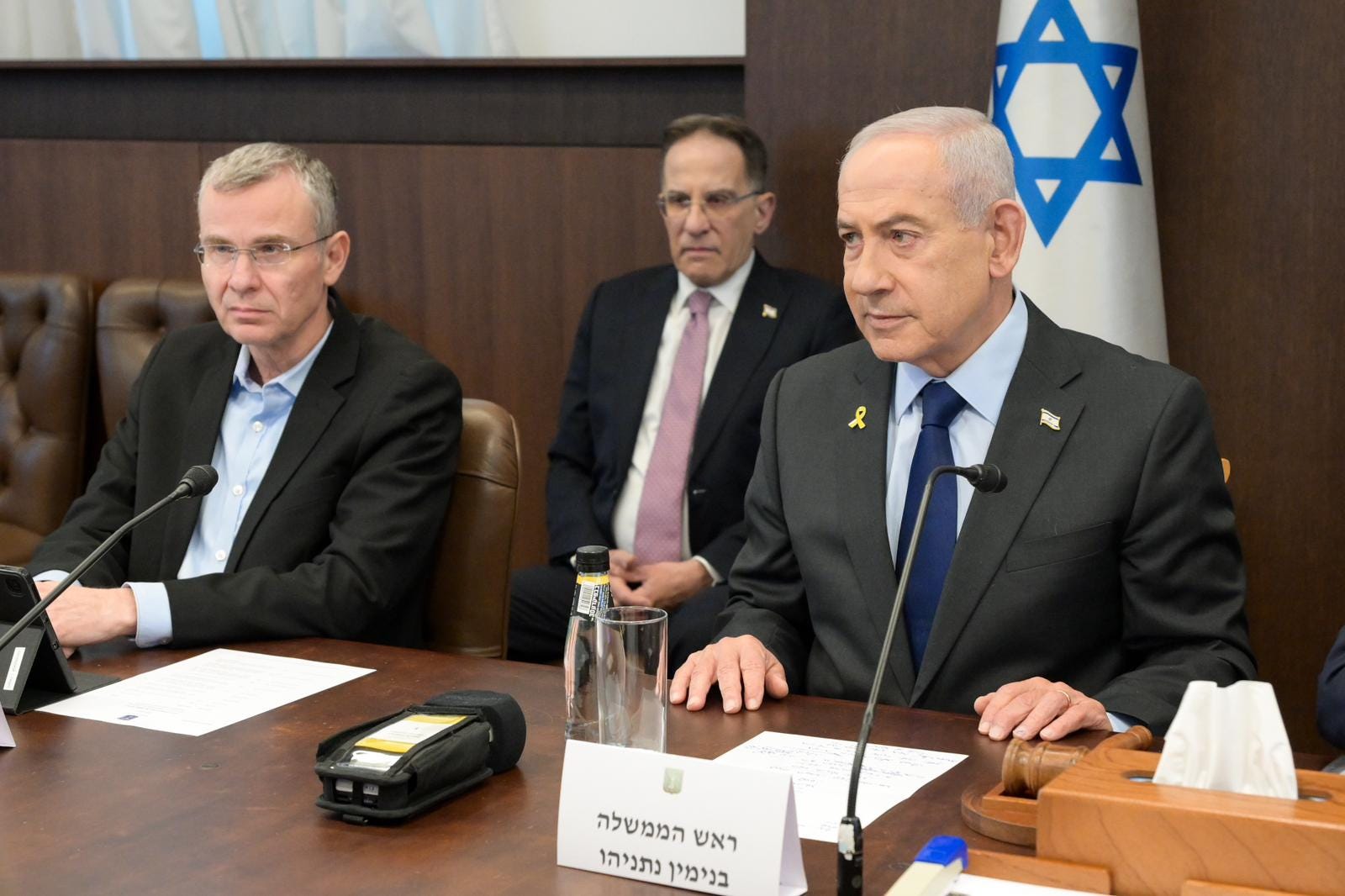
Israeli Prime Minister Benjamin Netanyahu expressed support for the protests, stating that Israel “identifies with the struggle of the Iranian people.”
“The government of Israel, the State of Israel, and my own policies—we identify with the struggle of the Iranian people, with their aspirations for freedom, liberty and justice,” he said.
“It is quite possible that we are at a moment when the Iranian people are taking their fate into their own hands.”
The European External Action Service (EEAS) said the European Union was monitoring the demonstrations and expressed concern over Iran’s violent response.
“We call on Iranian authorities to uphold the rights to freedom of expression, association and peaceful assembly and to enable the free flow of information and access to the internet,” a press release said.
“All individuals arrested for peacefully exercising their rights should be immediately released.”
Across the Iranian diaspora, many have criticized the government for its crackdown on the protests. Maryam Rajavi, co-leader of the opposition group People’s Mojahedin Organization of Iran (MEK), said protesters “struck fear into a weakened enemy.”
“Scenes of your courage, valor, and steadfast resistance captivate the conscience of the world,” she wrote on her website.
“Therefore, from here, I say to the clerics, the Revolutionary Guards, the Basij forces, and their intelligence agents: Whatever measures you take, you will not be able to silence a people who have resolved to overthrow the clerical regime,” she continued.
“You may kill, you may wound, you may arrest and imprison, but you will not escape the relentless wrath of this nation. And let this stand as an explicit warning to all those who order and carry out these crimes and killings: The courts of a free Iran are awaiting you.”
Iranian American journalist and activist Masih Alinejad told Fox News that Trump’s threats of U.S. intervention sent people “a strong message” of hope, saying he is on the right side of history.
“The United States of America is not going to have a negotiation with these killers, and that is why they’re welcoming the strong message of President Trump,” she said.
“I believe President Trump is serious, and he will take action against our killers.”
This comes as protests supporting demonstrations in Iran have spread worldwide, including in Canada, the United Kingdom, the United States, and Australia.
 The Introspective
Leave a comment