
A decade after Freddie Gray’s death in police custody, Baltimore reflects on changes in policing, community response, and the national conversation on police violence.
Dante Belcher
Apr 16, 2025
Content Warning: This article contains discussions of police brutality, racial violence, and death. Reader discretion is advised.
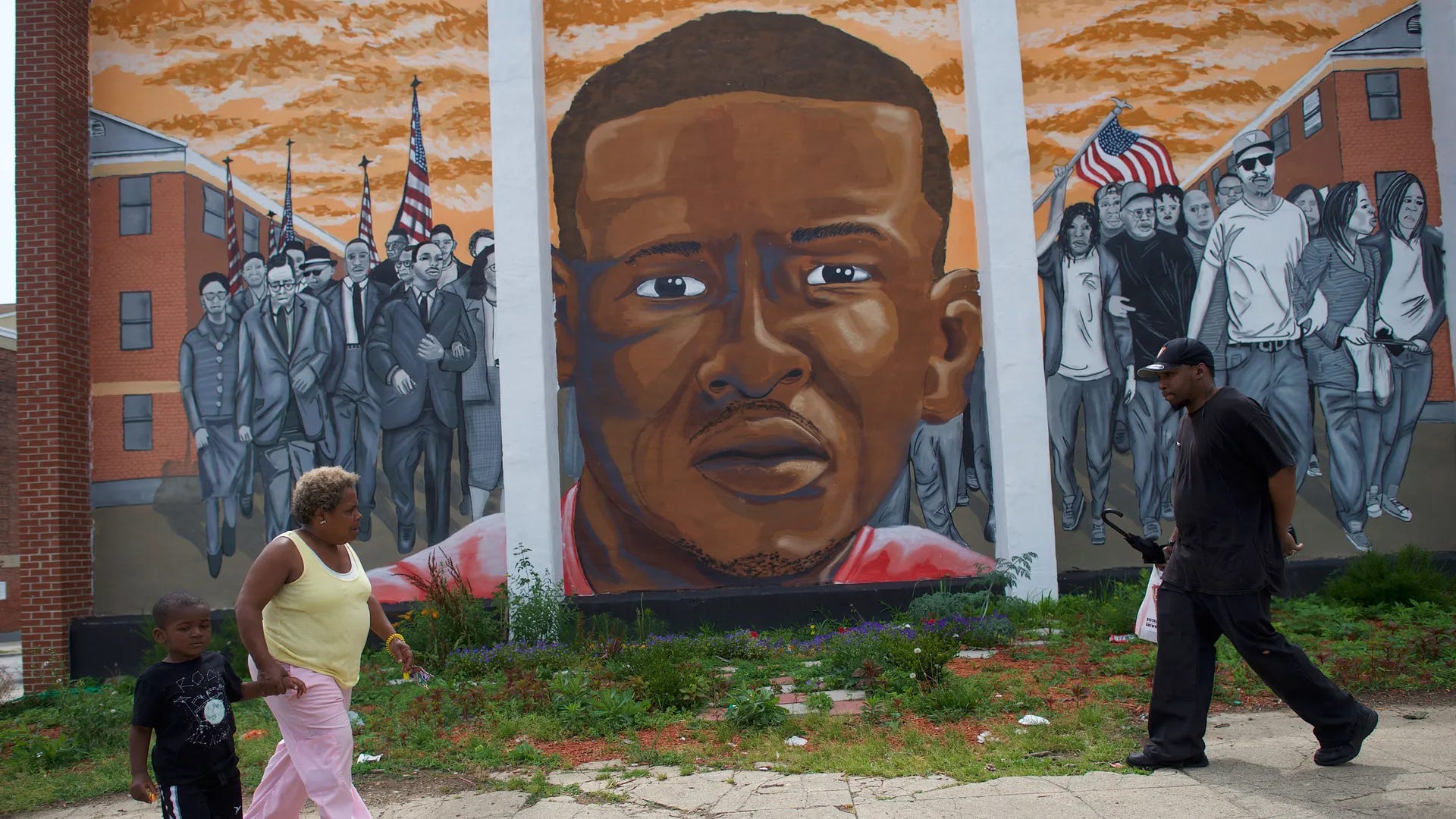
Ten years ago this week, Freddie Gray, a 25-year-old Black man, was killed in police custody after being arrested by the Baltimore Police Department for possessing a knife. While being transported to the police station, officers failed to secure Gray inside the police van, causing him to sustain fatal injuries to his cervical spinal cord. He died a week later. His death, ruled a homicide, sparked widespread outrage, leading to mass protests and civil unrest until the National Guard was deployed in Baltimore.
The six officers charged in Gray’s death—Caesar R. Goodson Jr., William G. Porter, Brian W. Rice, Edward M. Nero, Garrett Miller, and Alicia D. White—either had their charges dropped or were acquitted. Porter’s trial ended in a mistrial.
In the aftermath, the Baltimore Police Department (BPD) pledged to address systemic corruption and misconduct, including allegations of excessive force, unlawful searches, and wrongful arrests. But in the years since, accusations of abuse—primarily against the city’s predominantly Black population—have persisted. This has continued despite significant declines in Baltimore’s crime and murder rates throughout the 2020s, amid growing public distrust of BPD and intensified scrutiny of law enforcement following the 2020 killings of George Floyd and Breonna Taylor.
But as a Baltimore native, what changed within BPD? And how much work remains?
Baltimore Then and Now
Following Gray’s killing, a 2016 investigation into the Baltimore Police Department (BPD) by the Department of Justice (DOJ) found that officers routinely engaged in actions that violated the First and Fourth Amendments and federal laws, including unlawful searches and seizures, as well as excessive and deadly force — all in violation of civil rights.
“We found that BPD has engaged in a pattern or practice of serious violations of the U.S. Constitution and federal law that has disproportionately harmed Baltimore’s African American community and eroded the public’s trust in the police,” said then-Assistant Attorney General Vanita Gupta in a 2016 press release.
“The agency also fails to provide officers with the guidance, oversight and resources they need to police safely, constitutionally and effectively.”
A report from The Baltimore Banner highlights sharp declines in arrests since Gray’s death. In 2015, more than 25,000 people were arrested by BPD, compared to 15,563 arrests in 2024.
However, in that same report, Lucky Crosby, a resident of West Baltimore’s Sandtown-Winchester neighborhood—where Gray was arrested—said disparities in community relations with police remain. He recalled that, as a child, officers used to patrol on foot and engage with youth directly.
“They would snatch us on the corner and teach us boxing, teach us how to play pool and ping-pong,” said Crosby.
“That’s gone, you only see them after someone is murdered, after someone is harmed, after the crime.”
In a 2021 CNN interview, community leaders continued to express dissatisfaction with BPD. Alex Long, an organizer with Safe Streets, an initiative aimed at curbing youth gun violence, recalled an instance of officers ignoring a dangerous situation.
“Last month, I had to wrestle a young man down because he tried to shoot someone in the head, there were four officers standing on the corner who walked in the opposite direction,” Long said.
“There wouldn’t be such an outcry for help from the communities if there was so much change.”
In that same report, then-Police Commissioner Michael Harrison dismissed the incident, stating it had not been brought to his attention. He added that BPD was still in the midst of cultural change.
“We’re still changing the culture in the police department to a professional culture where officers respond appropriately, and they can get past their fears or perceptions about what they think will happen to them if they make a mistake,” Harrison said.
Despite many reforms promised under the consent decree, a 2024 report by WYPR found that large portions remain unfulfilled, with 15% of the mandate untouched.
This follows a report by The Real News Network, which revealed unreliable data reporting by BPD. The report noted growing discrepancies between statistics on Open Baltimore—a city-run public data portal—and those reported to the FBI’s Uniform Crime Report (UCR). Some arrests listed in the UCR were excluded from Open Baltimore, with the data gap widening over time.
“The refusal to properly share, let alone collect, this data also enables police misconduct,” wrote Megan Kenny and Brandon Soderberg, the authors of the report.
Further transparency issues were raised by The Baltimore Sun, which reported that BPD had failed to track how often officers engaged in vehicle pursuits. When asked about the absence of this data, BPD spokesperson Chakia Fennoy told the Sun the department “did not possess any data on vehicle pursuits.”
Following public backlash, the department eventually released the data, despite initially claiming it did not exist.
In January 2025, Fox Baltimore uncovered new allegations of corruption within the department. A lawsuit filed against Deputy Police Commissioner Brian Nadeau, former Commissioner Michael Harrison, and Public Integrity Bureau Chief Olufemi Akanni accused them of “weaponizing the investigative and disciplinary powers” of the department to intimidate officers.
“The Baltimore City Police Department, and the highest-ranking officials in that department, engaged in a pattern of corruption intended purely on intimidating or retaliating against officers in their own ranks,” said attorney Michael Turiello.
According to the lawsuit, BPD’s internal affairs division allegedly targeted officers Jeffrey and Raquel Lilly due to a dispute over the ownership of puppies following the 2022 murder of James Blue, a family member. Deputy Commissioner Nadeau reportedly involved himself in the dispute between the Lillys and Blue’s widow, Capt. Lekeshia Blue, who worked in BPD’s Public Integrity Bureau.
“On Feb. 8, 2022, Jeffrey Lilly met with Deputy Commissioner Nadeau and Director Akanni at BPD headquarters,” the lawsuit read.
“During the meeting, Deputy Commissioner Nadeau made statements to intimidate Mr. Lilly into abandoning the pursuit of his property and ending his efforts to enforce his contract.”
Attorneys further alleged that Nadeau suppressed a more thorough inquiry.
“Brian Nadeau, specifically, at the top of the Public Integrity Bureau, instructed officers on how to handle the investigation,” said attorney Patrick Jennings.
“He was on email correspondence where officers repeatedly said, ‘This isn’t right, we’re not comfortable doing this, this isn’t the way this case should be investigated,’ and he continued to ramp up the pressure.”
Jennings emphasized that ongoing corruption persists despite the DOJ-imposed consent decree.
“If this can happen to them, if this can happen during a consent decree, while the Department of Justice, a DOJ monitor and his team is charging the city millions and millions of dollars for his work… Until everyone knows what’s happening at BPD, I don’t think anything meaningful will change.”
Despite the ongoing issues within BPD, Baltimore has seen a sharp decline in crime and homicides throughout the 2020s. In 2024, the city recorded 197 homicides—the lowest since 2011. This marked a significant drop from 2015, when Baltimore reported 344 homicides, the highest since 1993.
Police Brutality Since 2015
Research from NBC News revealed that between 1,000 and 1,300 people were killed by police annually between 2013 and 2023, with documented police killings increasing each year from 2019 to 2023. Black people, Indigenous Americans, and Native Hawaiians and Pacific Islanders were killed at higher rates compared to white people.
“Police violence hasn’t stopped,” Sirry Alang, a professor at the University of Pittsburgh, said in the report.
“It hasn’t decreased, despite all of the attention that we’ve had, socially or politically.”

An investigation by The Washington Post, launched after the 2014 killing of Michael Brown—an 18-year-old in the St. Louis suburb of Ferguson, Missouri—found that fatal police encounters reported to the FBI were undercounted by more than half. The gap in reporting has widened in recent years. The investigation also revealed that local police departments are not required to report officer-involved fatalities to the federal government, a policy that has drawn criticism as 2024 saw the highest number of people killed by police on record.
“This rise in police violence, even as homicides and violent crime decline nationwide, is a deeply troubling trend that demands data-backed solutions,” Campaign Zero, an organization that runs the Mapping Police Violence database, said in a statement to USA Today.
In Baltimore, a 2021 report from the American Civil Liberties Union (ACLU) found that between 2015 and 2019, more than 13,000 complaints of misconduct were filed against over 1,000 officers with the Baltimore Police Department. During the same period, there were 22,884 incidents involving the misuse of force. More than 91% of those cases involved Black residents, who make up over 60% of the city’s population.
“Although a few officers will undoubtedly continue to be arrested and charged with criminal behavior,” the report read.
“Countless others will escape responsibility and be known as a danger only to those in the neighborhoods they patrol.”
Statewide, 63% of people killed by police in Maryland are Black, even though Black residents make up only 31% of the state’s population. Prior to Freddie Gray’s death, from 2005 to 2011, officers across Maryland—including Baltimore and 18 counties—were charged with more than 271 crimes, 138 of which were violent offenses.
From Freddie Gray to George Floyd: How 2020 Reignited Black Lives Matter
The killing of George Floyd in 2020—during which Minneapolis police officer Derek Chauvin kneeled on Floyd’s neck for more than nine minutes on video—sparked global outrage and mass civil unrest across the United States. In the wake of his death, various police departments announced sweeping changes to their conduct. A report from The Guardian found that instances of officers using neck restraints dropped nearly 90%, with 112 cases reported in 2020, compared to 973 in 2019. However, instances of excessive force have risen in the years since, with an estimated 300,000 people subjected to it annually.
“It shows that policy can make a difference, but overall use of force didn’t change,” said Samuel Sinyangwe, founder of the Mapping Police Violence database, adding that there is still a long way to go in ending police brutality.
“The approach that cities and states took to reduce use of force after George Floyd’s murder was just not aligned to the severity of the problem. The overall goal of making communities safer from police violence has not been achieved.”
Experts applauded the convictions of Chauvin and the other officers involved in Floyd’s death. Chauvin was convicted of murder and manslaughter and is serving both a state and federal sentence for violating Floyd’s civil rights. The other officers—Thomas Lane, J. Alexander Kueng, and Tou Thao—each received prison sentences ranging from three to four years. However, experts caution that these convictions alone will not solve the broader issue of police brutality.
“The conviction of those officers isn’t enough because the problem isn’t a matter of individuals. It’s systemic and it requires changes that impact policies and practices on the collective level,” said Anthony Pinn, a professor at Rice University, in an interview with Anadolu Agency.
“The conviction of those officers is important, but it doesn’t render Black people safe on a societal level. The demand for systemic changes is still as important as ever.”
In the years since Floyd’s death, many states have passed legislation promoting “tough-on-crime” policies or repealed reforms aimed at addressing police brutality, often as part of a broader backlash against policies that promote diversity, equity, and inclusion (DEI).
In 2024, Georgia enacted laws rolling back key criminal justice reforms passed in 2018, including a new requirement for cash bail in many cases. That same year, Tennessee blocked legislation that would have reformed how police handle traffic stops, including a proposed law in Memphis created after the 2023 killing of Tyre Nichols, a 29-year-old Black man who was beaten to death by officers.
“I think what’s most important for us to remember is that we can give law enforcement tools, but we’ve got to hold law enforcement to a standard of using those tools appropriately, where there’s an appropriate interaction with the public,” Tennessee Gov. Bill Lee said to the Associated Press after vetoing the bill.
In November 2024, Maryland Gov. Wes Moore signed controversial legislation allowing children ages 10 to 12 to be charged with crimes including illegal gun possession, auto theft, animal cruelty, and sex offenses.
Supporters of the legislation argued it would ultimately help young people in need.
“It’s not to throw them in jail or anything like that,” Baltimore State’s Attorney Ivan Bates told CBS Baltimore.
“It’s to get them the services that they really need and that they’re crying out for based on their actions.”

Despite backlash to 2020-era reforms, studies have shown that the Black Lives Matter movement had a significant influence on the 2020 presidential election. The authors of one study noted that the unrest in 2020 shaped outcomes in key swing states and laid the groundwork for a rise in conservative backlash throughout the decade.
“Given how close the election was in key battleground states, our findings suggest that the BLM movement may have played a decisive role in determining the election outcome,” said Dr. Klein Teeselink, one of the study’s authors.
“This represents one of the most consequential impacts of a social movement on electoral politics in recent history.”


Leave a Reply