
President Trump’s second-term inauguration coincides with TikTok’s unexpected revival, leaving users and experts questioning the broader implications.
Dante Belcher
Jan 20, 2025
After a tumultuous 24 hours following TikTok’s brief ban in the U.S., the popular social media app restored service for U.S. users Sunday after President Donald Trump reassured the company’s service providers.
“I’m asking companies not to let TikTok stay dark! I will issue an executive order on Monday to extend the period of time before the law’s prohibitions take effect, so we can make a deal to protect our national security. The order will also confirm that there will be no liability for any company that helped keep TikTok from going dark before my order,” Trump wrote in a Truth Social post.
The short-lived ban followed years of criticism surrounding the Chinese-owned app, ByteDance, which is headquartered in Beijing. Concerns over national security, partly fueled by the volatile relations between the U.S. and China, played a major role in the decision.
Timeline of Events
Criticism of TikTok began in 2020 when President Trump issued an executive order threatening to ban the app unless it was sold to a U.S.-based company within 45 days, citing national security concerns.
“This 45-day delay will give Microsoft and other interested purchasers time to reach a deal with TikTok’s owners that adequately addresses the national security concerns posed by the app,” a White House official said in an Axios report.
TikTok began routing all U.S. user data to Texas-based software company Oracle following sustained pressure from Congress. This move was part of Project Texas, a $1.5 billion plan aimed at reassuring Americans that TikTok was secure to use. The Biden administration later banned the app for federal government employees, with exceptions for law enforcement and national security purposes.
In March 2023, TikTok CEO Shou Zi Chew testified before Congress to address safety concerns regarding the app. During the hearing, Chew explained how the app is “free from any manipulation by any government.”
“That’s what we’ve been doing for the last two years, building what amounts to a firewall to seal off protected U.S. user data from unauthorized foreign access. The bottom line is this: American data stored on American soil, by an American company, overseen by American personnel,” Chew said, according to a report by CNET.
In March 2024, the Protecting Americans from Foreign Adversary-Controlled Applications Act (PAFACA) was passed by the House of Representatives. The bipartisan bill bans apps and websites deemed “foreign adversary-controlled applications” within 270 days of designation. The bill was later passed by the Senate and signed into law in April 2024. TikTok and ByteDance sued the federal government in May 2024, arguing the bill was unconstitutional.
The Department of Justice sued TikTok in August 2024 for allegedly violating the Children’s Online Privacy Protection Act of 1998 (COPPA), a landmark law that restricts websites from collecting information from children under 13. The state of Texas filed its own lawsuit against TikTok in October, accusing the app of violating state law by sharing children’s personal information without parental consent. During that same period, more than 12 states, including Washington D.C., filed lawsuits against TikTok over mental health concerns related to minors.
“They’ve chosen profit over the health and safety, well-being, and future of our children, and that is not something we can accept. So, we’ve sued,” California Attorney General Rob Bonta said, according to the Associated Press.
The lawsuits centered on TikTok’s algorithm, particularly the app’s “For You” section, which showcases the user’s interests. The lawsuits accused the app of designing features to addict children to the platform, citing examples like push notifications and the ability to “endlessly scroll.”
In December, the U.S. Court of Appeals ruled that the PAFACA bill was constitutional, upholding the ban on TikTok. Then-President-elect Donald Trump later asked the Supreme Court for a pause on the TikTok ban, claiming he could “save” the app without infringing on the First Amendment or compromising national security.
“President Trump alone possesses the consummate dealmaking expertise, the electoral mandate, and the political will to negotiate a resolution to save the platform while addressing the national security concerns expressed by the government,” read the legal briefing.
On January 17, the Supreme Court upheld the law banning TikTok unless its ownership is divested from parent company ByteDance, citing national security concerns. The app later went offline on January 18, shortly before 11 p.m. EST. American users attempting to use the app were met with a message that read:
“A law banning TikTok has been enacted in the U.S. Unfortunately, that means you can’t use TikTok for now. We are fortunate that President Trump has indicated that he will work with us on a solution to reinstate TikTok once he takes office. Please stay tuned!”
The app began restoring service to users on Sunday, following Trump’s reassurances to service providers.
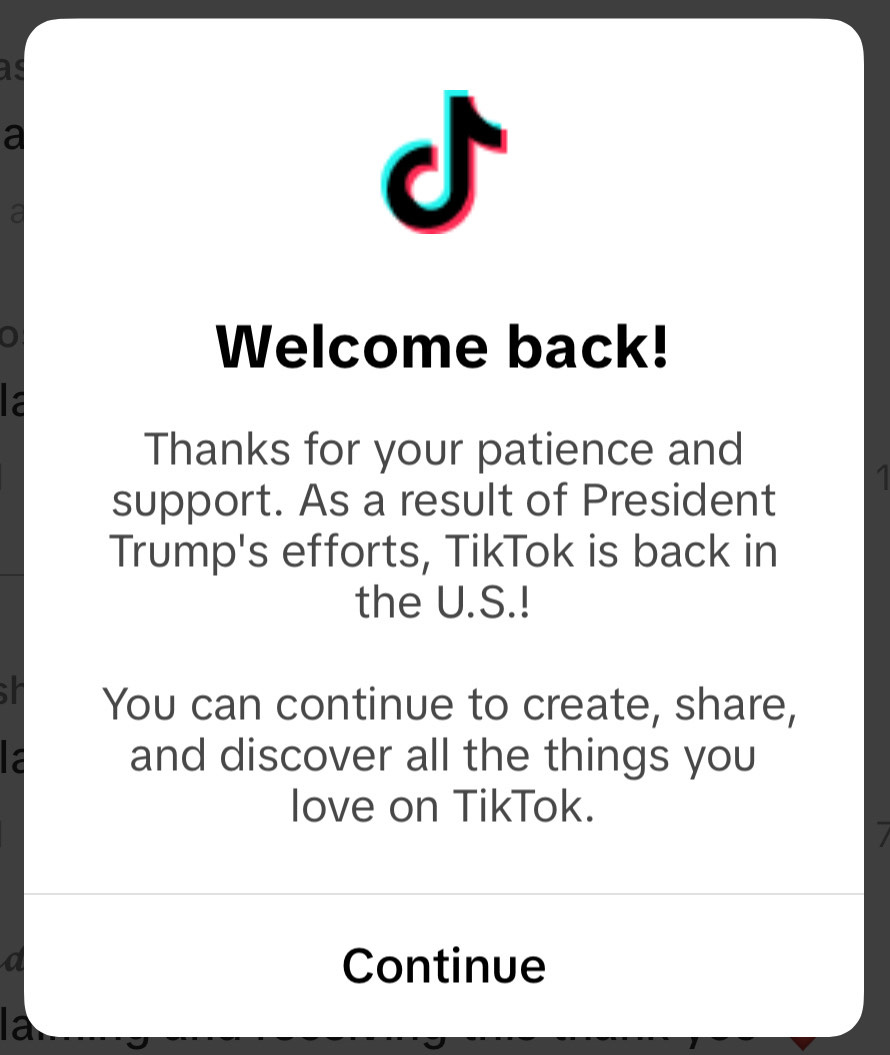
After the app’s restoration, users were greeted with a message that read: “Welcome back! Thanks for your patience and support. As a result of President Trump’s efforts, TikTok is back in the U.S.!”
Trump’s Role in TikTok’s Return
Trump has offered to issue an executive order following his inauguration on Monday to grant TikTok a 90-day extension for the ban, giving the president time to negotiate a deal to sell the app to a non-Chinese company.
However, House Speaker Mike Johnson condemned Trump’s efforts to halt TikTok’s ban in an interview with NBC’s Meet the Press, claiming that China is “manipulating” American children.
“It’s not the platform that members of Congress are concerned about. It’s the Chinese Communist Party and their manipulation of the algorithms. They have been flooding the minds of American children with terrible messages glorifying violence, anti-Semitism, and even suicide and eating disorders. I mean, crazy kinds of stuff, and they’re mining the data of American citizens. It’s a very dangerous thing,” Johnson said.
Shark Tank star Kevin O’Leary and former Los Angeles Dodgers owner Frank McCourt have expressed interest in acquiring TikTok from ByteDance, without its famed algorithm.
“By keeping the platform alive without relying on the current TikTok algorithm and avoiding a ban, millions of Americans can continue to enjoy the platform. We look forward to working with ByteDance, President-elect Trump, and the incoming administration to get this deal done,” McCourt said in a press release.
ByteDance has refused to sell TikTok to U.S. investors, in part because of the app’s algorithm, which influences which videos appear on the app’s “For You” page.
User Reaction and Public Sentiment
Since TikTok’s revival after being banned, many users celebrated the app’s return on social media.
“TIKTOK IS BACK. WE SURVIVED 13 HOURS WITHOUT IT,” wrote one user on X.
Another user pointed out that President Trump was the first to call for the TikTok ban.
“We thank Donald Trump—HE IS THE REASON TIKTOK IS BANNED IN AMERICA IN THE FIRST PLACE. NEVER FORGET,” wrote another user.
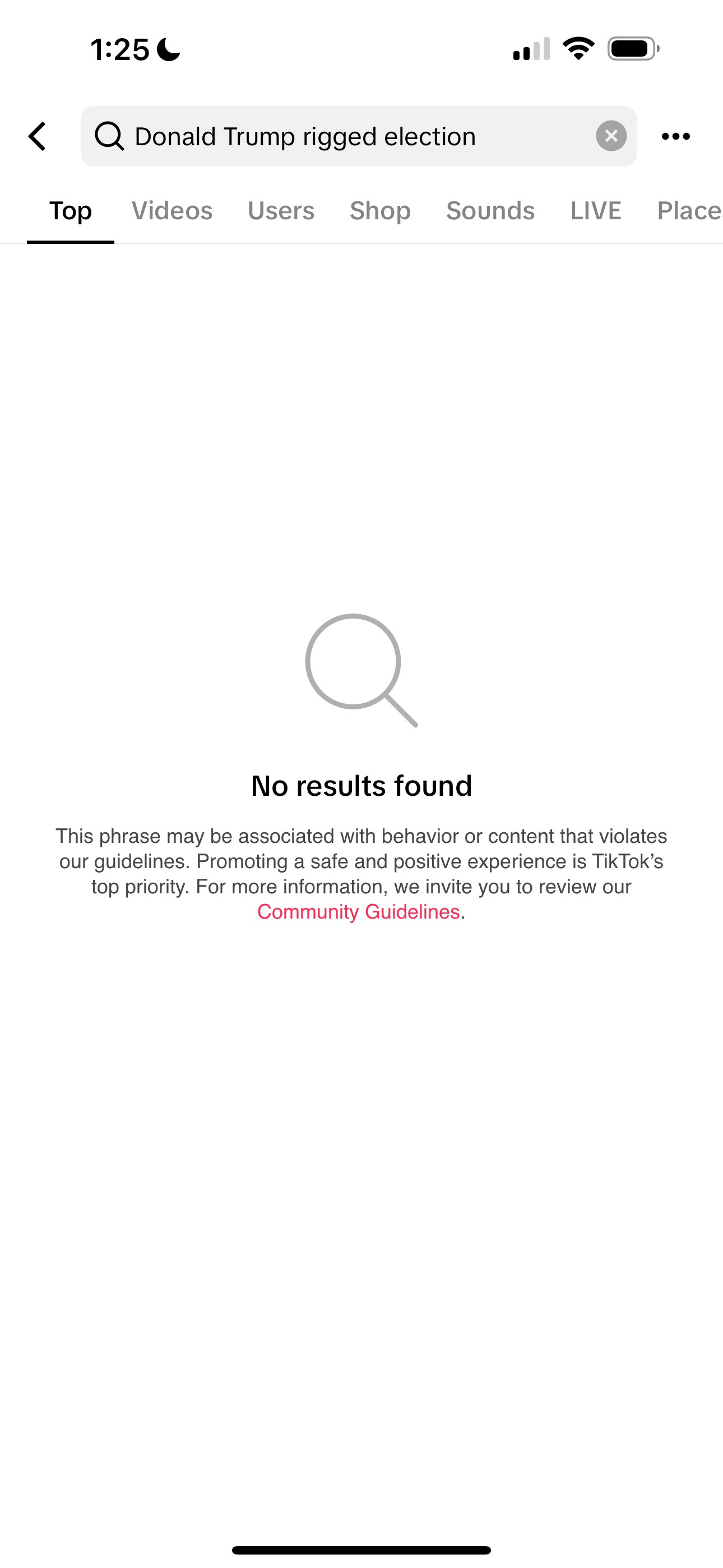
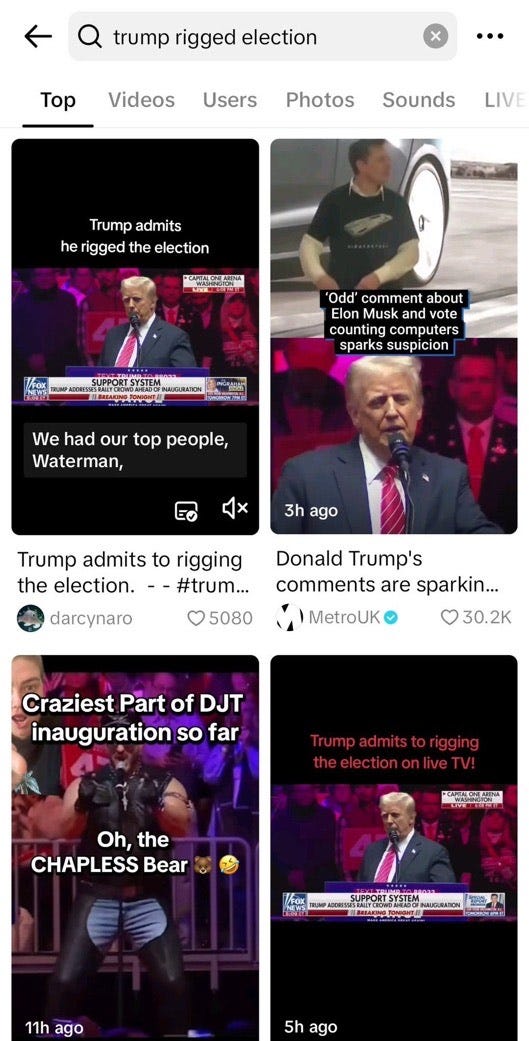
However, many users have noticed more censorship since TikTok’s restoration, with some alleging that searching for terms such as “Donald Trump rigged election”—in reference to claims the president made regarding his 2024 victory and the 2020 election at his D.C. rally Sunday night before his second inauguration—led to no search results for U.S. users. International users, however, had no such issue.
“American TikTok is censored and they’re not even trying to hide it,” said a user on X.
Uncertainty regarding TikTok’s future has led to the rise of the Chinese social media app RedNote (known as Xiaohongshu or “Little Red Book” in China) among U.S. users. The app includes a mix of shopping, videos, pictures, and online communities.
RedNote became the top-downloaded app on the Apple App Store, adding more than 700,000 new users to the app’s 300 million users. The sudden popularity of RedNote among U.S. users has also led to cultural exchanges between Chinese and American users, with one user’s request for help with their English language homework going viral.
Broader Implications for Tech Policy
The increasing involvement of tech billionaires in Trump’s second term has sparked discussions about the influence of the world’s wealthiest people in the new administration. Among the guests attending Trump’s inauguration on Monday were Apple CEO Tim Cook, Facebook and Meta founder Mark Zuckerberg, Amazon founder Jeff Bezos, and TikTok CEO Shou Zi Chew.
Elon Musk, the world’s wealthiest person, earning $421 billion a year, was announced in November to lead the newly created “Department of Government Efficiency,” a proposed arm of government by President Trump.
Meta has faced controversy for ending its Diversity, Equity, and Inclusion (DEI) programs. This move comes after new company guidelines that now allow for discriminatory language towards LGBTQ people.
“We do allow allegations of mental illness or abnormality when based on gender or sexual orientation, given political and religious discourse about transgenderism and homosexuality and common non-serious usage of words like ‘weird,’” read the company guidelines.
The new changes to the hate speech guidelines removed rules that prohibited insults about someone’s appearance based on race, ethnicity, disability, religion, sexual orientation, sex, gender identity, and illness. Meta also removed policies that banned hate speech based on protected classes and rules that prohibited users from discriminating against transgender and nonbinary people.
LGBTQ media advocacy group GLAAD released a statement criticizing these changes.
“With these changes, Meta is continuing to normalize anti-LGBTQ hatred for profit—at the expense of its users and true freedom of expression. Fact-checking and hate speech policies protect free speech,” said President and CEO Sarah Kate Ellis in a statement.
Other corporations, such as Amazon, McDonald’s, and Walmart, have also announced the end of their DEI policies in recent weeks.


Leave a Reply