
This week saw major developments in trade, healthcare, federal authority, and historical preservation policy.
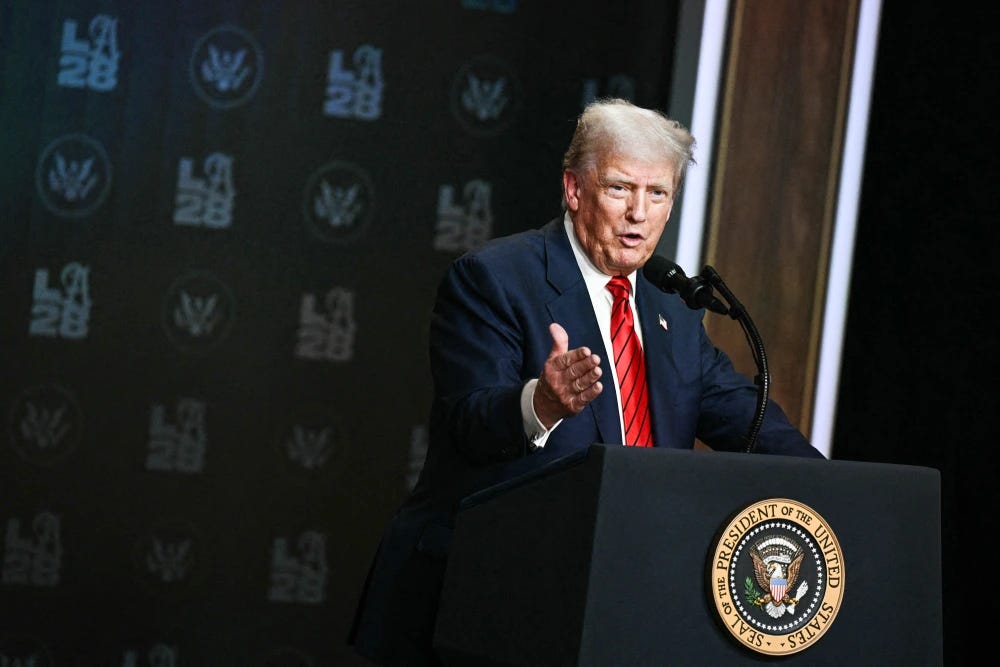
Trump’s 29th week brought further lawsuits and developments in healthcare, trade, and policy. More than 16 states and Washington, D.C., have sued the Trump administration over efforts to ban gender-affirming care for transgender youth, following a previous report from The Introspective highlighting the Supreme Court’s decision to uphold Tennessee’s ban on such care for minors.
At the same time, Trump threatened to federalize Washington, D.C., after a member of the Department of Government Efficiency (DOGE) was carjacked—raising concerns, as the 1973 Home Rule Act granted D.C. residents the right to self-governance. Meanwhile, backlash erupted after portions of the Constitution—including references to habeas corpus—were temporarily removed from Congress’ website due to a “coding error.” The Constitution was later fully restored.
Following a prior Introspective report detailing Director of National Intelligence (DNI) Tulsi Gabbard’s accusation that former President Barack Obama fabricated claims of Russian interference in the 2016 election to discredit Trump, Attorney General Pam Bondi launched a grand jury probe into the former Obama administration, alleging a “treasonous conspiracy.” That same day, the National Park Service (NPS) announced it would reinstall a statue of Confederate General Albert Pike in Washington, D.C., after the statue was removed by protesters after the killing of George Floyd in 2020.
Meanwhile, the Department of Health and Human Services (HHS) announced the cancellation of more than $500 million in vaccine development, stating that mRNA technology—used in COVID-19 vaccines—posed a “risk.”
As the trade war escalates, Trump imposed an additional 25% tariff on India—raising the total to 50%—in response to the country’s continued oil purchases from Russia amid the war in Ukraine. Days later, Trump announced a 100% tariff on computer chips, with exemptions for chips produced in the United States.
Lawsuits, D.C. Takeover, and the Constitution
Following a previous Introspective report detailing the Supreme Court’s decision to uphold Tennessee’s ban on gender-affirming care for minors, 16 states and Washington, D.C., have sued the Trump administration, alleging an “unconstitutional pressure campaign” against transgender youth.
“The result is an atmosphere of fear and intimidation experienced by transgender individuals, their families and caregivers, and the medical professionals who seek only to provide necessary, lawful care to their patients,” the lawsuit reads.
“These efforts to chill the provision of healthcare for adolescents — even in states where such care is legal and protected — show that the agency defendants have adopted and are engaged in a systematic effort to leverage the threat of criminal and civil enforcement to eliminate medically necessary care for transgender adolescents in the United States.”
In a press release, New York Attorney General Letitia James, who is leading the lawsuit, claimed the federal government is running a “cruel and targeted” harassment campaign against healthcare providers.
“This administration is ruthlessly targeting young people who already face immense barriers just to be seen and heard, and are putting countless lives at risk in the process. In New York and nationwide, we will never stop fighting for the dignity, safety, and basic rights of the transgender community,” she said.
The White House acknowledged the lawsuit, with spokesperson Taylor Rogers stating that Americans support Trump’s efforts to stop what she called “the despicable mutilation and chemical castration of children,” using transphobic language to describe gender-affirming care.
“The president has the lawful authority to protect America’s vulnerable children through executive action, and the administration looks forward to ultimate victory on this issue,” Rogers said.
The lawsuit follows a pair of executive orders signed by Trump in January: one recognizing only two sexes—male and female—and another titled Protecting Children From Chemical and Surgical Mutilation, which seeks to ban gender-affirming care nationwide.
At the same time, Trump threatened to federalize Washington, D.C., after Edward Coristine, a prominent member of the Department of Government Efficiency (DOGE), was carjacked and assaulted in the Logan Circle neighborhood on Sunday.
“Crime in Washington, D.C., is totally out of control. Local ‘youths’ and gang members, some only 14, 15, and 16 years old, are randomly attacking, mugging, maiming, and shooting innocent citizens, at the same time knowing that they will be almost immediately released,” Trump wrote on Truth Social.
“They are not afraid of law enforcement because they know nothing ever happens to them, but it’s going to happen now! If D.C. doesn’t get its act together, and quickly, we will have no choice but to take federal control of the city, and run this city how it should be run, and put criminals on notice that they’re not going to get away with it anymore. Perhaps it should have been done a long time ago, then this incredible young man, and so many others, would not have had to go through the horrors of violent crime. If this continues, I am going to exert my powers, and FEDERALIZE this city.”

According to D.C. police (MPD), two 15-year-olds from Hyattsville, Maryland, were arrested and charged with unarmed carjacking. The investigation remains ongoing. However, Trump doubled down on his threat during remarks to reporters, using inflammatory language toward the suspects.
“I have to say that somebody from DOGE was very badly hurt … a young man who was beat up by a bunch of thugs in D.C., and either they’re gonna straighten their act out in terms of government and in terms of protection, or we’re gonna have to federalize and run it the way it’s supposed to be run,” he said.
Trump later threatened to deploy the National Guard to Washington, D.C., claiming crime rates were “ridiculous,” despite MPD data showing violent crime is down 26% from the previous year. He also threatened to overturn the Home Rule Act, the 1973 law granting D.C. residents the right to elect their own mayor and city council.
“We’re going to look at that—in fact, they are, the lawyers are already studying it,” Trump said.
“We have to run D.C. This has to be the best-run place in the country, not the worst-run place in the country. And it has so much potential, and we’re going to take care of it.”
 D.C. Home Rule Act
Trump then announced that, beginning Friday at midnight, federal officers — including police, the FBI, Drug Enforcement Administration (DEA), Bureau of Alcohol, Tobacco, Firearms and Explosives (ATF), divisions of Immigration and Customs Enforcement (ICE), and other agencies — would begin patrolling the streets of Washington, D.C., as he moved to federalize the nation’s capital.
Meanwhile, backlash ensued after parts of the Constitution—including the writ of habeas corpus and the Foreign Emoluments Clause—were removed from Congress’ official website. Internet archives show that the changes occurred between June and August.
“The privilege of the writ of habeas corpus shall not be suspended, unless when in cases of rebellion or invasion the public safety may require it,” reads the removed section on habeas corpus.
“No preference shall be given by any regulation of commerce or revenue to the ports of one state over those of another: nor shall vessels bound to, or from, one state, be obliged to enter, clear, or pay duties in another,” reads a separate removed clause.
In a post on X, the Library of Congress acknowledged the removal, attributing it to a “coding error.”
“It has been brought to our attention that some sections of Article I are missing from the Constitution Annotated website,” the post read.
“We have been working to correct this and expect it to be resolved soon.”
A previous report from The Introspective highlighted comments by White House Deputy Chief of Staff Stephen Miller suggesting that Trump may suspend habeas corpus amid rising anti-immigrant sentiment.
“The Constitution is clear, and that, of course, is the supreme law of the land—that the privilege of the writ of habeas corpus can be suspended in a time of invasion,” Miller said.
“So, I would say that’s an option we’re actively looking at.”
Russiagate, Vaccines, and Confederate Statues
Following a previous report from The Introspective highlighting DNI Tulsi Gabbard accusing former President Barack Obama of fabricating claims that Russian interference in the 2016 election helped Trump win, Attorney General Pam Bondi launched a grand jury probe into the Obama administration, alleging a “treasonous conspiracy” against Trump. She previously announced a “strike force” to analyze evidence provided by Gabbard.
“The Department of Justice is proud to work with my friend Director Gabbard, and we are grateful for her partnership in delivering accountability for the American people,” Bondi said in a press release.
“We will investigate these troubling disclosures fully and leave no stone unturned to deliver justice.”
A former DOJ official criticized the investigation as a “dangerous political stunt,” and a former senior national security official also noted that previous investigations found no evidence.
“There’s no logical, rational basis for this,” the official told NBC News.
At the same time, the National Park Service (NPS) announced that the statue of Confederate General Albert Pike—which was torn down by protesters in 2020—would be restored and reinstalled in Washington, D.C.’s Judiciary Square neighborhood.
“The restoration aligns with federal responsibilities under historic preservation law as well as recent executive orders to beautify the nation’s capital and reinstate pre-existing statues,” the NPS said in a statement.
Following the announcement, Rep. Eleanor Holmes Norton said she would introduce legislation to permanently remove the statue and place it in a museum.
“The decision to honor Albert Pike by reinstalling the Pike statue is as odd and indefensible as it is morally objectionable. Pike served dishonorably. He took up arms against the United States, misappropriated funds, and was ultimately captured and imprisoned by his own troops,” Norton said in a press release.
“A statue honoring a racist and a traitor has no place on the streets of D.C.”
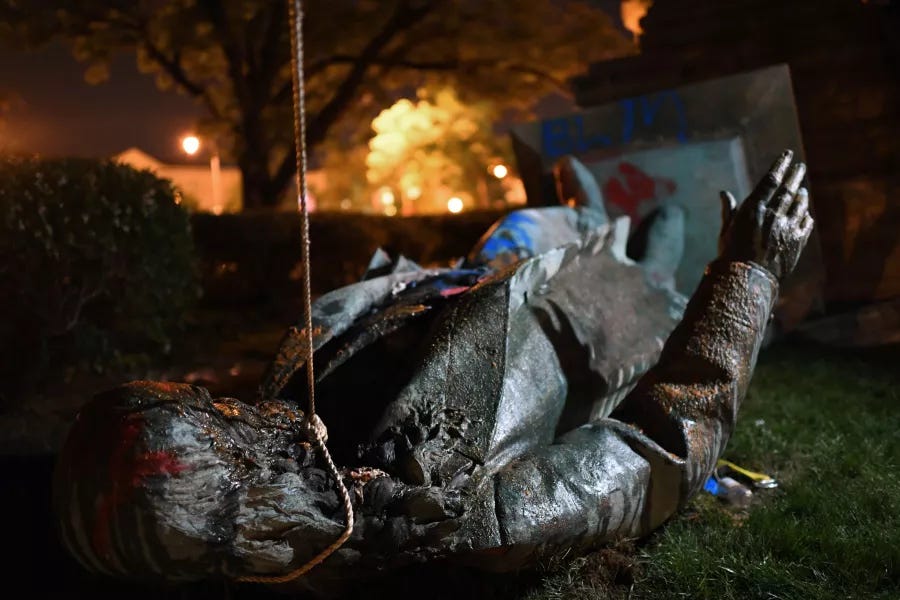
The statue is expected to be on public display again in October.
Meanwhile, Health Secretary Robert F. Kennedy Jr. canceled $500 million in vaccine development related to mRNA technology, impacting contracts with Emory University and Tiba Biotech.
“After reviewing the science and consulting top experts at NIH and FDA, HHS has determined that mRNA technology poses more risk than benefits for these respiratory viruses,” Kennedy said in a video posted to X.
“Let me be absolutely clear: HHS supports safe, effective vaccines for every American who wants them.”
“That’s why we’re moving beyond the limitations of mRNA for respiratory viruses and investing in better solutions,” he added.
In a separate post on X, Jerome Adams—the surgeon general during Trump’s first term—criticized Kennedy’s announcement.
“I’ve tried to be objective & non-alarmist in response to current HHS actions — but quite frankly this move is going to cost lives,” he wrote.
“mRNA technology has uses that go far beyond vaccines… and the vaccine they helped develop in record time is credited with saving millions.”
Sen. Bill Cassidy called Kennedy’s decision “unfortunate” and accused the health secretary of “wasting” already invested resources.
“He has also conceded to China an important technology needed to combat cancer and infectious disease,” Cassidy wrote.

However, many applauded the decision. Children’s Health Defense, a group that advocates against vaccines, echoed Kennedy’s concerns over mRNA technology.
“While we believe that the mRNA shots on the market are unsafe and should be off the market, this is a welcome step in the right direction. The pandemic preparedness industry as it exists today is a threat to human welfare,” CEO Mary Holland wrote on X.
Trade
With the trade war ongoing, President Trump imposed an additional 25% tariff on India after the country purchased oil from Russia, raising the total tariff rate to 50%.
“I determine that it is necessary and appropriate to impose an additional ad valorem duty on imports of articles of India, which is directly or indirectly importing Russian Federation oil,” Trump said in an executive order. The tariffs are set to take effect within 25 days.
India’s Ministry of External Affairs criticized the executive order as “unfair, unjustified, and unreasonable.”
“Our imports are based on market factors and done with the overall objective of ensuring the energy security of 1.4 billion people of India,” the ministry said in a statement.
“It is therefore extremely unfortunate that the U.S. should choose to impose additional tariffs on India for actions that several other countries are also taking in their own national interest.”

According to an analysis, China was the largest importer of Russian oil, purchasing $62.5 billion worth. India was the second-largest importer, with nearly $53 billion in purchases.
Meanwhile, Trump threatened to impose a 100% tariff on semiconductors—a type of computer chip used in most electronics—with exemptions for chips produced in the U.S.
“We’ll be putting a tariff on of approximately 100% on chips and semiconductors, but if you’re building in the United States of America, there’s no charge, even though you’re building and you’re not producing yet,” Trump said.


Leave a Reply