
From federalizing D.C. policing to cultural oversight, the president’s latest actions mark a deepening executive reach.
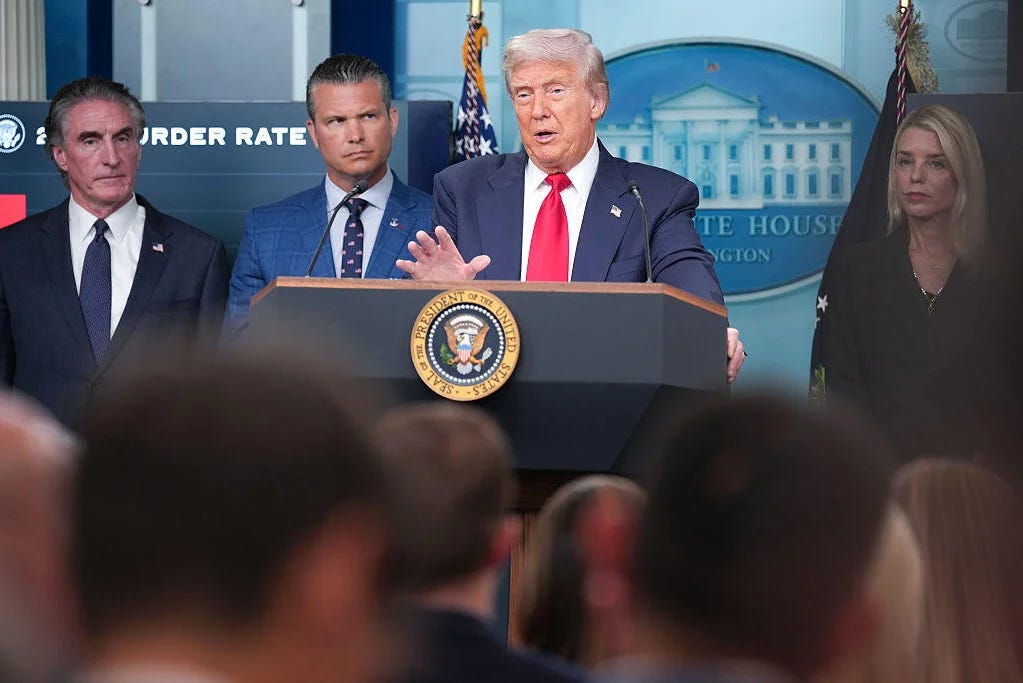
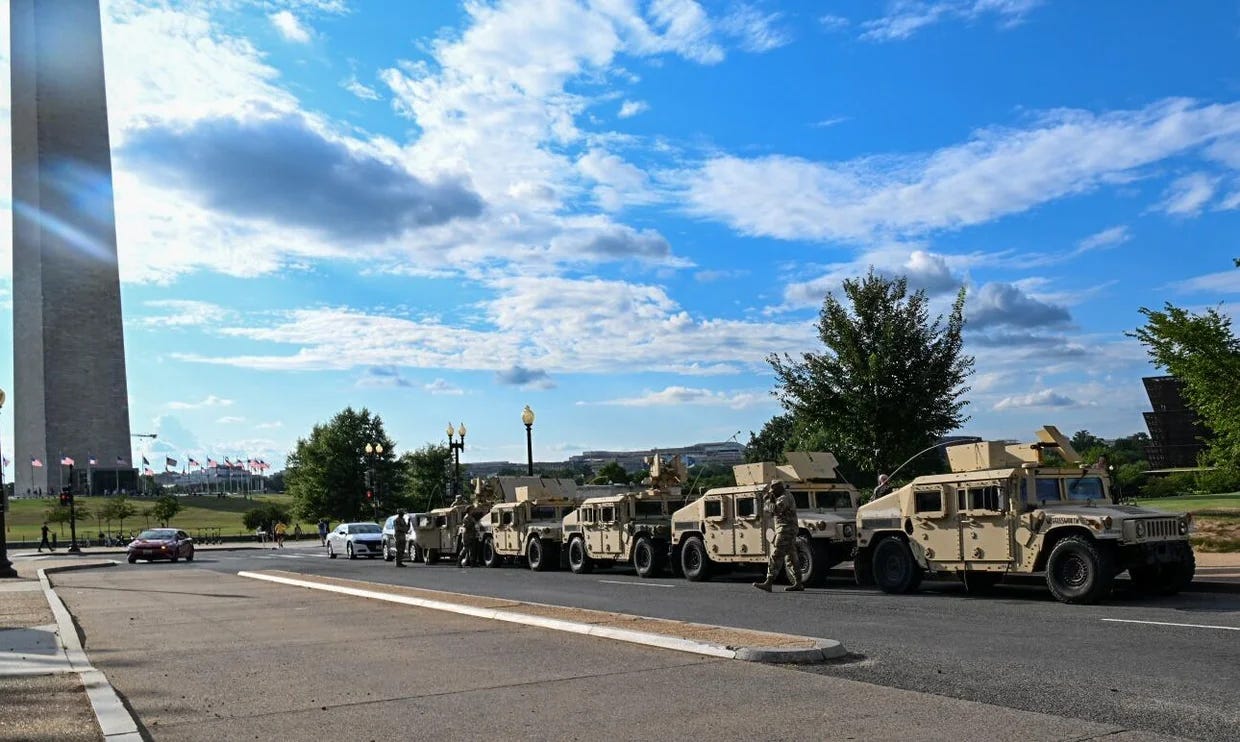
Trump’s 30th week brought updates to government oversight, economic leadership and the Jeffrey Epstein scandal. Trump placed the D.C. Police Department (MPD) under federal control for at least 30 days. This follows a previous report from The Introspective detailing Trump’s threat to federalize the city after a member of the Department of Government Efficiency (DOGE) was carjacked. Trump later deployed the National Guard to the capital city as the Pentagon develops a “Domestic Civil Disturbance Quick Reaction Force.”
Trump also nominated E.J. Antoni—a member of Project 2025’s Heritage Foundation—to lead the Bureau of Labor Statistics (BLS) after a previous Introspective report detailed the president firing former BLS Commissioner Erika McEntarfer following a weak jobs report showing a slowdown in hiring throughout May and June. At the same time, the Smithsonian Institution was ordered by the White House to review exhibits that align with Trump’s directive to “celebrate American exceptionalism, remove divisive or partisan narratives, and restore confidence in our shared cultural institutions.” The Smithsonian’s National Museum of American History previously faced backlash after removing Trump from an exhibit detailing presidential impeachments, sparking concerns of censorship.
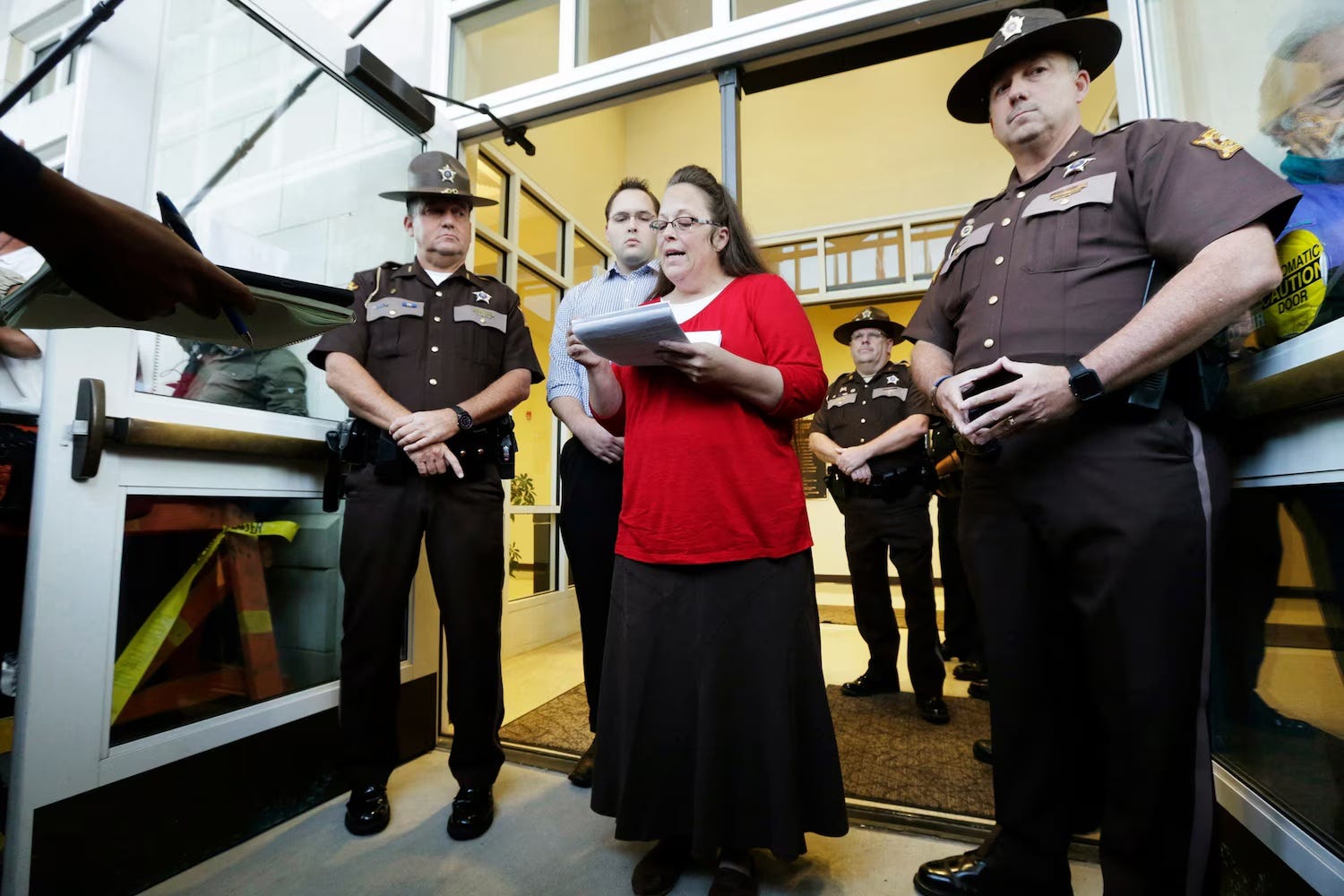
The Supreme Court was asked to overturn Obergefell v. Hodges, the 2015 ruling that legalized same-sex marriage nationwide, after former Kentucky clerk Kim Davis—who faced backlash in 2015 for refusing to issue marriage licenses to same-sex couples on religious grounds—wrote a petition to the court.
As the Jeffrey Epstein scandal continues, a federal judge denied a request from the Trump administration to unseal grand jury material regarding Ghislaine Maxwell, a former socialite and long-time associate of the late child sex offender. Meanwhile, Trump is considering reclassifying marijuana as a less dangerous drug.
Federal Control of D.C. and National Guard
Following a previous report detailing the carjacking of DOGE member Edward Coristine in the city’s Logan Circle neighborhood, Trump took federal control of the MPD from D.C. Mayor Muriel Bowser and deployed National Guard troops to the capital city, marking the second time the president deployed troops to a major city after protests in Los Angeles earlier this year.
“We’re here for a very serious purpose. Very serious, very,” Trump said Monday, noting that 800 members of the National Guard have been called.
“Something’s out of control. But we’re going to put it in control very quickly, like we did on the southern border. I’m announcing a historic action to rescue our nation’s capital from crime, bloodshed, bedlam and squalor and worse. This is Liberation Day in D.C., and we’re going to take our capital back.”
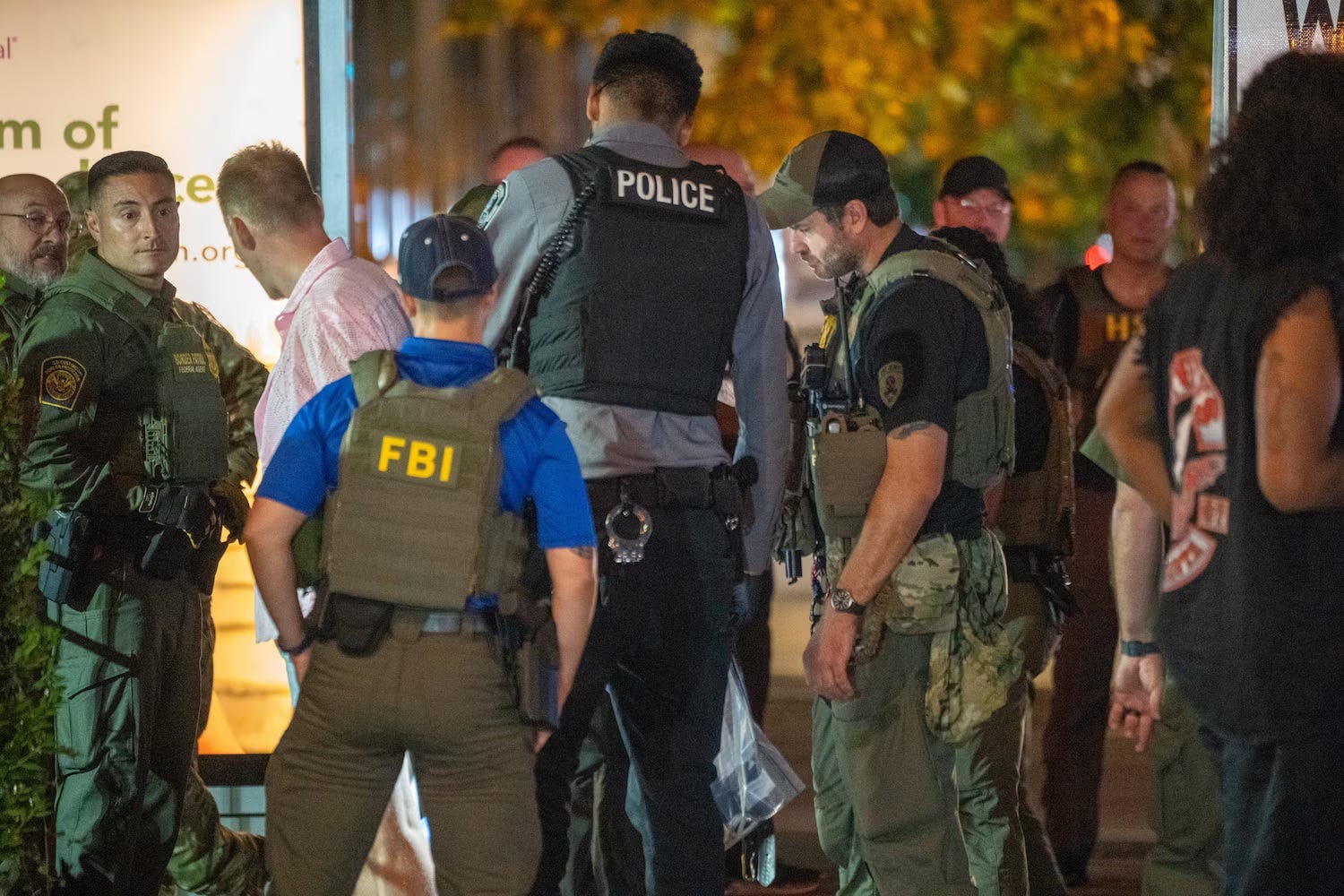
This came after the president posted to Truth Social on Sunday, claiming he would “make our Capital safer and more beautiful than it ever was before.”
“The Homeless have to move out, IMMEDIATELY,” he wrote.
“We will give you places to stay, but FAR from the Capital. The Criminals, you don’t have to move out. We’re going to put you in jail where you belong. It’s all going to happen very fast, just like the Border.”
Trump later signed an executive order directing Defense Secretary Pete Hegseth to mobilize the National Guard.
“The mobilization and duration of duty shall remain in effect until I determine that conditions of law and order have been restored in the District of Columbia,” the order read—despite Department of Justice (DOJ) data showing that crime in D.C. has hit a 30-year low.
Federalizing the D.C. police is addressed in the Home Rule Act, the 1973 law granting D.C. residents the right to elect their own mayor and city council. Section 740 of the act, which allows the president to seize control of the district’s police, had never been invoked prior to Monday.
“Notwithstanding any other provision of law, whenever the President of the United States determines that special conditions of an emergency nature exist which require the use of the Metropolitan Police force for Federal purposes, he may direct the Mayor to provide him, and the Mayor shall provide, such services of the Metropolitan Police force as the President may deem necessary and appropriate,” the section reads.
“In no case, however, shall such services made available pursuant to any such direction under this subsection extend for a period in excess of forty-eight hours unless the President has, prior to the expiration of such period, notified the Chairmen and ranking minority members of the Committees on the District of Columbia of the Senate and the House of Representatives, in writing, as to the reason for such direction and the period of time during which the need for such services is likely to continue.”
 DC Home Rule Act
Mayor Bowser responded to the deployment on Tuesday, emphasizing community involvement.
“This is a time where community needs to jump in and we all need to do what we can in our space, in our lane, to protect our city and to protect our autonomy, to protect our Home Rule, and get to the other side of this guy, and make sure we elect a Democratic House so that we have a backstop to this authoritarian push,” she said.
In an interview with Fox Business, D.C. Police Union Chairman Greggory Pemberton agreed with Trump’s decision, claiming that “something needs to be done,” despite crime in D.C. being down 26% from last year.
“The fact that we need help from federal law enforcement and maybe even the National Guard should not come as a surprise. We agree with that,” he said, noting that there are 800 vacancies within MPD.
“Every aspect of our criminal justice system in D.C. is broken, and every broken aspect can be traced back to radical activists on the city council.”
At the same time, The Washington Post reported that the Trump administration is planning to establish a “Domestic Civil Disturbance Quick Reaction Force” that would deploy National Guard troops to cities facing protests or unrest.
“The Department of Defense is a planning organization and routinely reviews how the department would respond to a variety of contingencies across the globe,” Pentagon spokesperson Kingsley Wilson said in a statement obtained by the Post.
“We will not discuss these plans through leaked documents, pre-decisional or otherwise.”
BLS Leadership, Smithsonian and Same-Sex Marriage
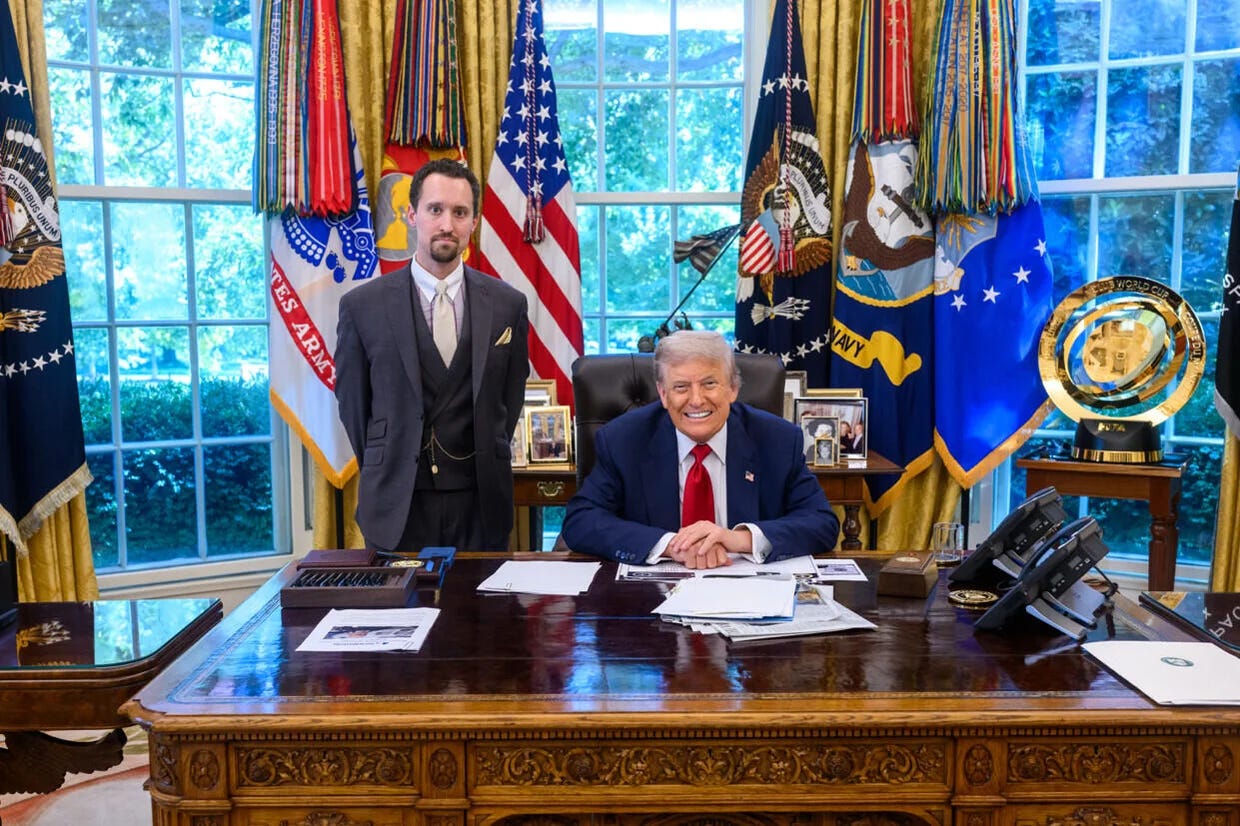
Trump nominated Heritage Foundation member E.J. Antoni as the new head of the BLS. This follows a previous report from The Introspective highlighting former Commissioner Erika McEntarfer’s firing after a weak jobs report.
“I am pleased to announce that I am nominating Highly Respected Economist, Dr. E.J. Antoni, as the next Commissioner of the Bureau of Labor Statistics,” Trump wrote on Truth Social.
“Our economy is booming, and E.J. will ensure that the numbers released are HONEST and ACCURATE. I know E.J. Antoni will do an incredible job in this new role.”
His nomination drew criticism from economists, including Jason Furman, a Harvard University professor, who called Antoni an “extreme partisan” with no “relevant expertise.”
“I don’t think I have ever publicly criticized any presidential nominee before,” Furman wrote on X.
“But E.J. Antoni is completely unqualified to be BLS commissioner. He would be a break from decades of nonpartisan technocrats.”
Jessica Riedl, an economist with the Manhattan Institute, also criticized Antoni’s nomination, writing that “the articles and tweets I’ve seen him publish are probably the most error-filled of any think tank economist right now.”
“I hope we see better at BLS,” she said on X.
That same day, the Smithsonian Institution was ordered by the White House to review exhibits that align with Trump’s directive to “reflect the unity, progress, and enduring values that define the American story,” according to a letter posted on the White House website.
“This initiative aims to ensure alignment with the President’s directive to celebrate American exceptionalism, remove divisive or partisan narratives, and restore confidence in our shared cultural institutions,” wrote Senior Associate Staff Secretary Lindsey Halligan, Domestic Policy Council Director Vince Haley and Office of Management and Budget Director Ross Vought in the letter.
The impacted museums include the National Museum of American History, National Museum of Natural History, National Museum of African American History and Culture, National Museum of the American Indian, National Air and Space Museum, Smithsonian American Art Museum, National Portrait Gallery and Hirshhorn Museum and Sculpture Garden.
The move follows a previous Introspective report detailing the Smithsonian’s National Museum of American History removing Trump from an exhibit on presidential impeachments. The museum later restored the exhibit after backlash.
“As the keeper of memory for the nation, it is our privilege and responsibility to tell accurate and complete histories,” the museum said, confirming that mentions of Trump were removed and noting it was “not asked by any administration or other government official to remove content from the exhibit.”
Meanwhile, former Kentucky clerk Kim Davis—who was jailed in 2015 for refusing to issue marriage licenses to same-sex couples on religious grounds—has asked the Supreme Court to overturn Obergefell v. Hodges, the landmark 2015 ruling that legalized same-sex marriage nationwide.
“If there ever was a case of exceptional importance,” wrote Davis’ attorney Mathew Staver in a petition, “the first individual in the Republic’s history who was jailed for following her religious convictions regarding the historic definition of marriage, this should be it.”
Kim Davis Petition
A previous Introspective report detailed nine states, including Idaho, Montana, North Dakota and South Dakota, introducing legislation to repeal the landmark ruling. That report also noted comments from Michigan Rep. Josh Schriver, who claimed that Obergefell “is at odds with the sanctity of marriage, the Michigan Constitution, and the principles upon which the country was established.”
Epstein Update and Marijuana Reclassification
As the Jeffrey Epstein scandal continues, U.S. District Judge Paul Engelmayer denied a request from the Trump administration to unseal grand jury material regarding Epstein associate Ghislaine Maxwell, stating that there is nothing in the records that would renew the case.
“The Government’s invocation of special circumstances, however, fails at the threshold,” Engelmayer wrote.
“Its entire premise — that the Maxwell grand jury materials would bring to light meaningful new information about Epstein’s and Maxwell’s crimes, or the Government’s investigation into them — is demonstrably false.”
“The materials do not identify any person other than Epstein and Maxwell as having had sexual contact with a minor. They do not discuss or identify any client of Epstein’s or Maxwell’s. They do not reveal any heretofore unknown means or methods of Epstein’s or Maxwell’s crimes. They do not reveal new venues at which their crimes occurred. They do not reveal new sources of their wealth. They do not explore the circumstances of Epstein’s death. They do not reveal the path of the Government’s investigation.”
Engelmayer Opinion
He later criticized the Trump administration’s quest for unsealing the documents as “disingenuous.”
“A member of the public, appreciating that the Maxwell grand jury materials do not contribute anything to public knowledge, might conclude that the Government’s motion for their unsealing was aimed not at ‘transparency’ but at diversion — aimed not at full disclosure but at the illusion of such,” he wrote.
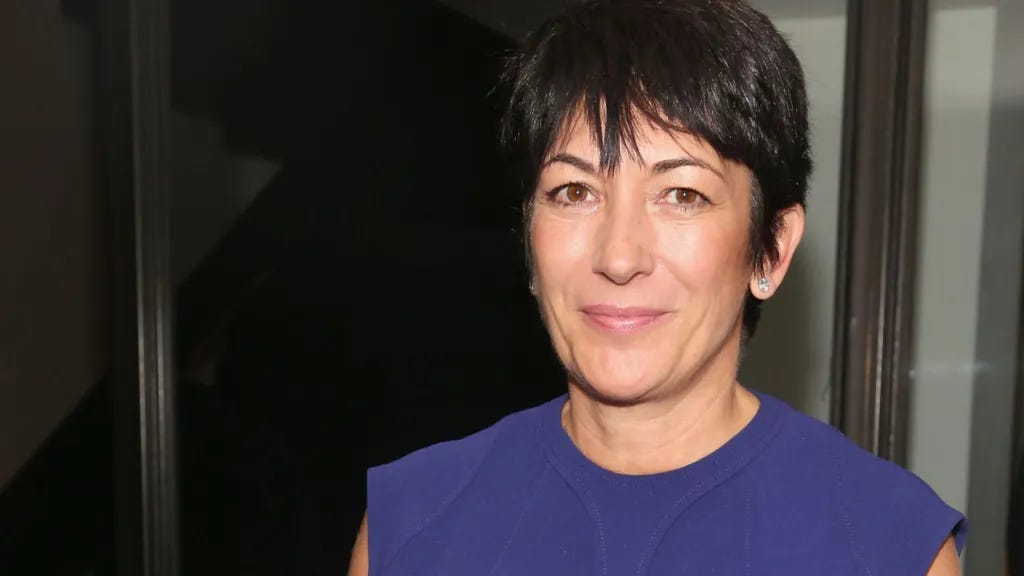
Maxwell is currently serving a 20-year sentence for sex trafficking, after being sentenced in 2022 following her association with the late child sex offender.
Meanwhile, President Trump said his administration would reclassify marijuana as a less dangerous drug.
“We’re looking at reclassification and we’ll make a determination over the next — I would say over the next few weeks, and that determination hopefully will be the right one. It’s a very complicated subject,” Trump said Monday.
Marijuana is currently classified as a Schedule 1 drug, alongside substances such as heroin and LSD, as “drugs with no currently accepted medical use and a high potential for abuse,” despite being legal for medical use in 40 states and recreational use in 24 states. The Wall Street Journal previously reported that the administration is considering moving marijuana to Schedule 3, which covers substances with a “moderate to low potential for physical and psychological dependence.”


Leave a Reply