
From transgender bans to federal workforce cuts, a look at the major developments in the latest week of the Trump administration.
Dante Belcher
Feb 16, 2025
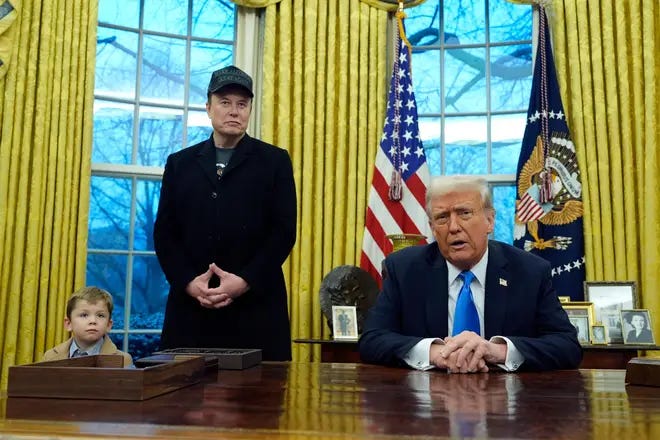
The fourth week of President Donald Trump’s second administration saw sweeping changes to LGBTQ+ rights, including a ban on transgender people serving or enlisting in the military and the elimination of gender-affirming care for transgender service members. The administration also removed the terms “transgender” and “queer” from federal websites, including the National Park Service, replacing the LGBTQ+ acronym with the outdated “LGB” as part of its broader rollback of diversity, equity, and inclusion (DEI) initiatives.
At the same time, Trump’s efforts to restructure the federal workforce—led in part by Elon Musk—have sparked legal challenges, with more than 14 states suing over drastic changes to government agencies. The newly established Department of Government Efficiency (DOGE) has gained access to Federal Emergency Management Agency (FEMA) funding, raising concerns as the U.S. Agency for International Development (USAID) faces budget cuts and layoffs that could impact millions in need of aid.
Meanwhile, Robert F. Kennedy Jr. was confirmed as secretary of health and human services. With a history of promoting medical racism, conspiracy theories, and anti-vaccine disinformation, his leadership could have significant implications for public health policy and the country’s response to future medical crises.
Transgender Rights and Policy Changes
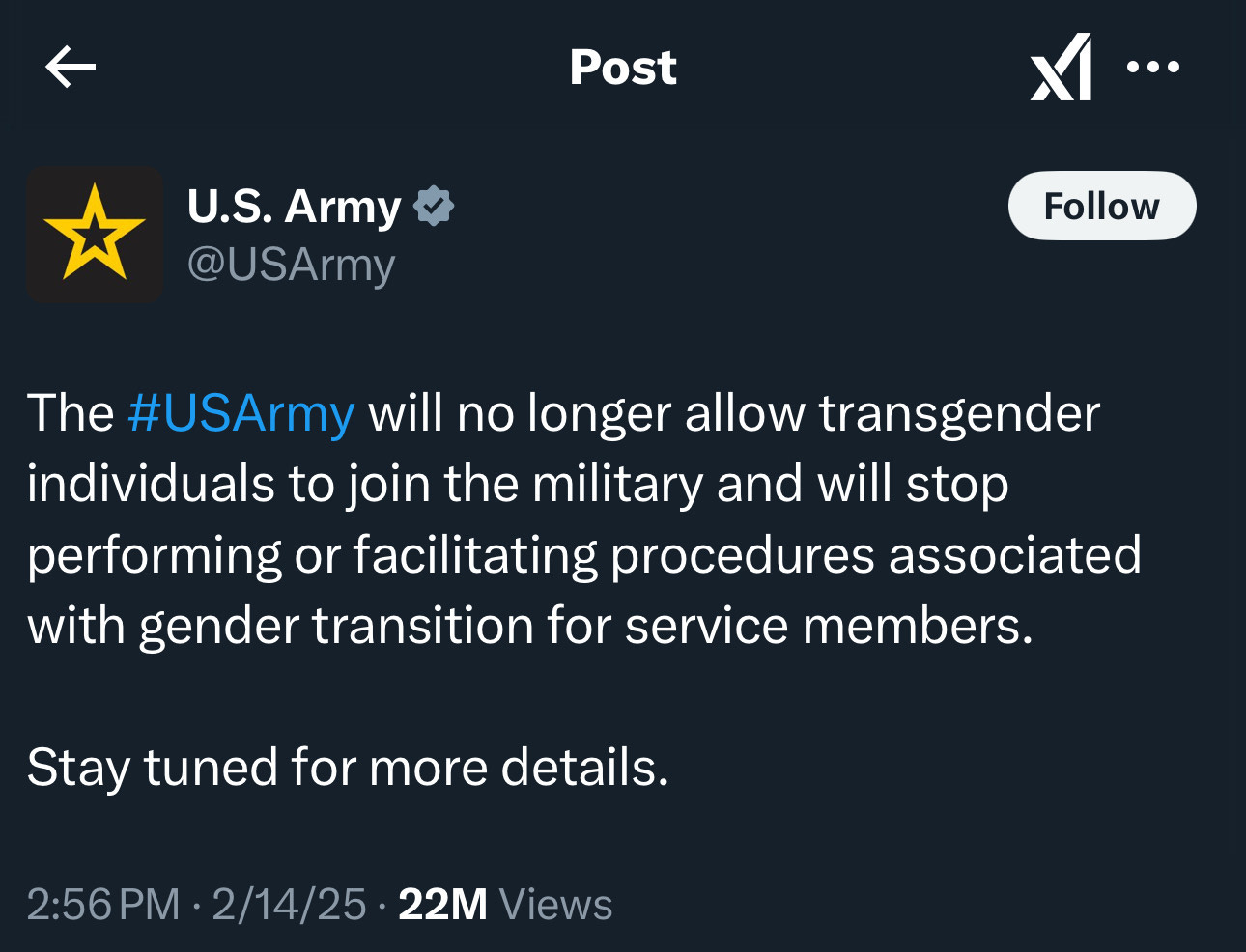
The U.S. Army enacted a ban on transgender people enlisting Friday and announced in an X post that it will stop providing gender-affirming care for service members.
“The #USArmy will no longer allow transgender individuals to join the military and will stop performing or facilitating procedures associated with gender transition for service members,” the post read.
The Army followed up with another post stating that troops with “gender dysphoria” have “volunteered to serve our country and will be treated with dignity and respect.”
The announcement came after former President Donald Trump signed an executive order on Jan. 27 directing the Pentagon to determine policies for transgender service members within 30 days.
The order, titled Prioritizing Military Excellence and Readiness, stated that expressing “a gender identity inconsistent with an individual’s sex conflicts with a soldier’s commitment to an honorable, truthful, and disciplined lifestyle, even in one’s personal life.” It further asserted that transgender troops “cannot satisfy the rigorous standards necessary for military service.”
In a Feb. 7 memo, Defense Secretary Pete Hegseth announced an immediate pause on recruiting transgender individuals and a halt to all gender-affirming care for service members.
“All unscheduled, scheduled, or planned medical procedures associated with affirming or facilitating a gender transition for service members are paused,” said the memo, which was obtained by The Guardian.
The announcement sparked immediate backlash. SPARTA Pride, a nonprofit organization for transgender and nonbinary service members and veterans, issued a statement condemning the decision.
“Transgender service members have been serving openly for almost ten years and currently fill critical roles in every branch and specialty, including infantry, aviation, nuclear engineering, law enforcement, and military intelligence, many requiring years of specialized training and expertise. The readiness and physical capabilities of transgender service members are no different from that of other service members,” the organization said in a press release.
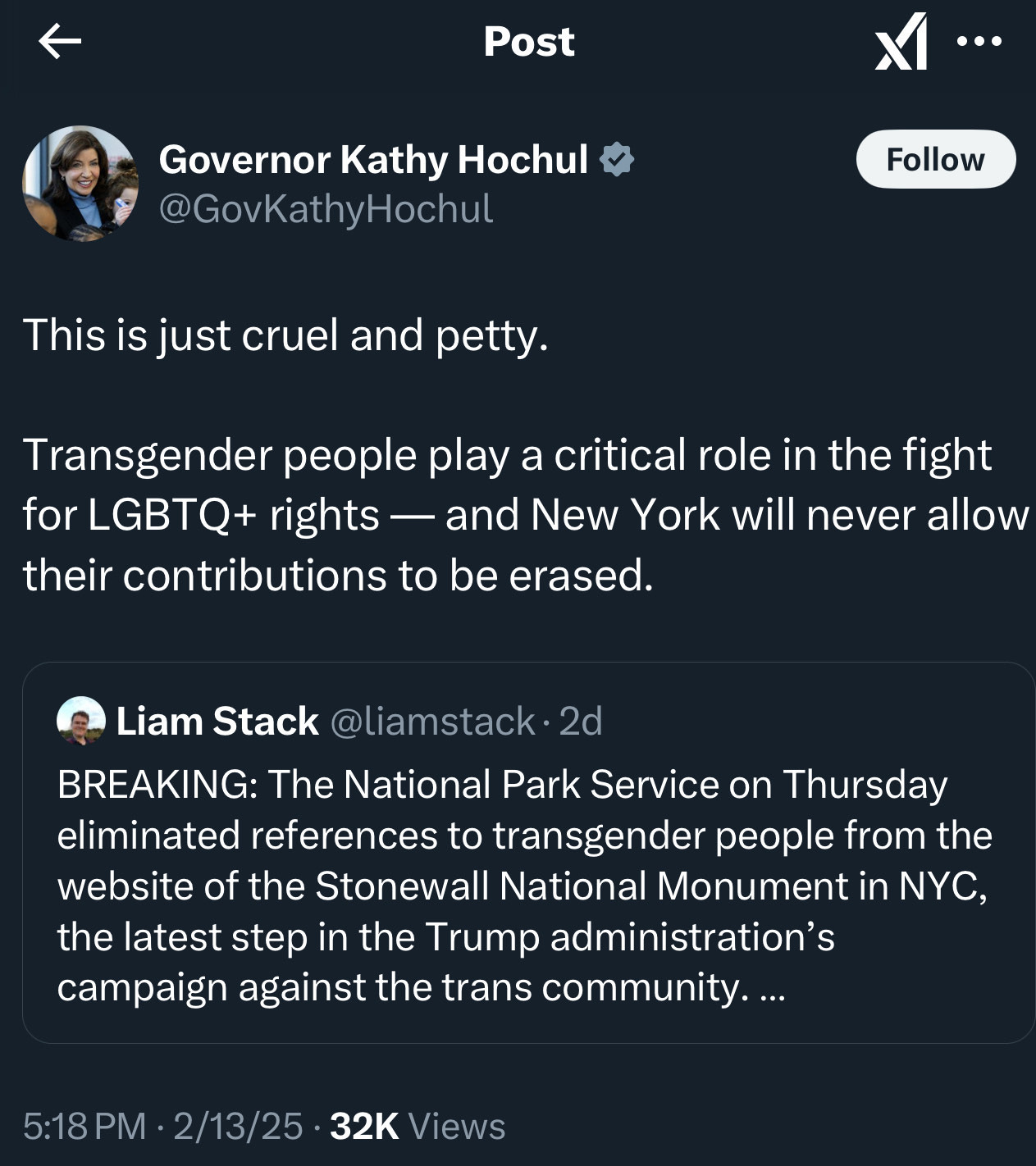
Following the military ban, the National Park Service (NPS) faced criticism Thursday after removing the terms “transgender” and “queer” from a website commemorating the 1969 Stonewall Riots—an event widely regarded as the catalyst for the modern LGBTQ+ rights movement. The website also replaced “LGBTQ” with the outdated acronym “LGB.”
These changes followed an executive order Trump signed on his first day in office, directing the federal government to define sex strictly as “male” or “female,” disregarding gender identity, as previously reported by The Introspective.
“This is just cruel and petty. Transgender people play a critical role in the fight for LGBTQ+ rights—and New York will never allow their contributions to be erased,” New York Gov. Kathy Hochul wrote in an X post.
The Stonewall Riots occurred on June 28, 1969, at the Stonewall Inn, an LGBTQ+ bar in New York City’s Greenwich Village, after bar patrons and neighborhood residents fought back against a police raid.
Representatives from LGBTQ+ advocacy group GLAAD and the Stonewall Inn also condemned the NPS’s decision, calling it an attempt to erase transgender people from history.
“This blatant act of erasure not only distorts the truth of our history, but it also dishonors the immense contributions of transgender individuals—especially transgender women of color—who were at the forefront of the Stonewall Riots and the broader fight for LGBTQ+ rights,” the organizations said in a joint press release, emphasizing the role of Marsha P. Johnson, a transgender woman who was integral to the uprising.
“Stonewall is transgender history. Marsha P. Johnson, Sylvia Rivera, and countless other trans and gender-nonconforming individuals fought bravely—often at great personal risk—to push back against oppressive systems. Their courage, sacrifice, and leadership were central to the resistance we now celebrate as the foundation of the modern LGBTQ+ rights movement.”
Meanwhile, two federal judges have temporarily blocked Trump’s executive order banning gender-affirming care for individuals under 19. U.S. District Judges Brendan Hurson and Lauren King, based in Baltimore and Seattle, issued separate rulings Thursday and Friday in response to lawsuits arguing that the order violates the Equal Protection Clause of the 14th Amendment, which guarantees that all people are treated equally under the law.
The Trump administration dismissed these claims in a court filing, arguing that federal agencies must implement the president’s policies.
“The president’s authority to direct subordinate agencies to implement his agenda, subject to those agencies’ own statutory authorities, is well established,” Justice Department attorneys wrote in a statement published by NPR.
Hurson and King were both appointed by former President Joe Biden.
Robert F. Kennedy, Jr. as Health Secretary
On Thursday, the Senate voted 52-48 to confirm Robert F. Kennedy Jr., a member of the Kennedy family, as health secretary for the Department of Health and Human Services, which oversees the Food and Drug Administration (FDA) and the Centers for Disease Control and Prevention (CDC).
Kennedy, who has a history of spreading vaccine disinformation dating back to 2005, faced opposition from both Democrats and Republicans, including Sen. Mitch McConnell, a polio survivor and the only Republican to vote against his confirmation.
“Individuals, parents, and families have a right to push for a healthier nation and demand the best possible scientific guidance on preventing and treating illness … but a record of trafficking in dangerous conspiracy theories and eroding trust in public health institutions does not entitle Mr. Kennedy to lead these important efforts,” McConnell said in a statement obtained by The New York Times.
In a 2021 interview with Fox News, Kennedy falsely claimed that vaccines cause autism, a theory that has been widely debunked.
“I do believe that autism comes from vaccines,” he said.
Democratic Sen. Chuck Schumer also opposed Kennedy’s confirmation, calling him “dangerous.”
“My colleagues on the Republican side, you know the consequences of what you’re doing,” Schumer said, according to Al Jazeera.
“You are not putting your constituents—their health, their families—first when you vote yes.”
During his confirmation hearing, Kennedy faced backlash over past comments promoting medical racism. In a 2021 interview, he suggested Black people should follow a different COVID-19 vaccine schedule because their immune systems are “better.”
“We should not be giving Black people the same vaccine schedule that’s given to whites because their immune system is better than ours,” he said.
Critics argue that such statements reinforce racist medical tropes, including the false belief that Black people have higher pain tolerances or inherently stronger immune systems. Sen. Angela Alsobrooks directly challenged Kennedy on his remarks during the hearing.
“So what different vaccine schedule would you say I should have received? With all due respect, that is so dangerous,” Alsobrooks said in a report by The Guardian.
She further criticized Kennedy’s role in spreading disinformation, stating, “These claims are made to seem positive, but they calcify the reality that there is disparate access to healthcare, and that has real implications for health and well-being.”
Following Kennedy’s confirmation, President Donald Trump signed an executive order establishing the “Make America Healthy Again Commission.” The commission, which includes federal officials such as the Environmental Protection Agency (EPA) administrator, will focus on addressing chronic disease.
The executive order highlights rising rates of cancer, obesity, diabetes, asthma, and autism spectrum diagnoses.
“Americans of all ages are becoming sicker, beset by illnesses that our medical system is not addressing effectively. These trends harm us, our economy, and our security,” the order states.
The commission has 100 days to submit a report assessing potential health risks associated with medication overuse, food additives, chemicals, and environmental exposures. The report will also evaluate the impact of antidepressants, antipsychotics, mood stabilizers, and weight-loss drugs.
A study by the University of California, Los Angeles (UCLA) found that antidepressants such as Zoloft, Lexapro, and Prozac significantly reduce suicide rates. Research from the CDC shows that more than 13% of American adults use these medications.
In addition to the initial report, the commission has 180 days to propose a strategy to reshape the federal government’s approach to chronic disease in children, including “ending federal practices that exacerbate the health crisis or unsuccessfully attempt to address it.”
Federal Workforce and Government Restructuring
Last week, Homeland Security Secretary Kristi Noem announced that Elon Musk—head of the temporary agency known as the Department of Government Efficiency (DOGE)—had been authorized to access disaster data from the Federal Emergency Management Agency (FEMA), including sensitive information about disaster victims. This development follows President Trump’s previous suggestion of shutting down FEMA, as reported by NBC News.
“I’ll also be signing an executive order to begin the process of fundamentally reforming and overhauling FEMA, or maybe getting rid of FEMA. I think, frankly, FEMA is not good,” Trump said.
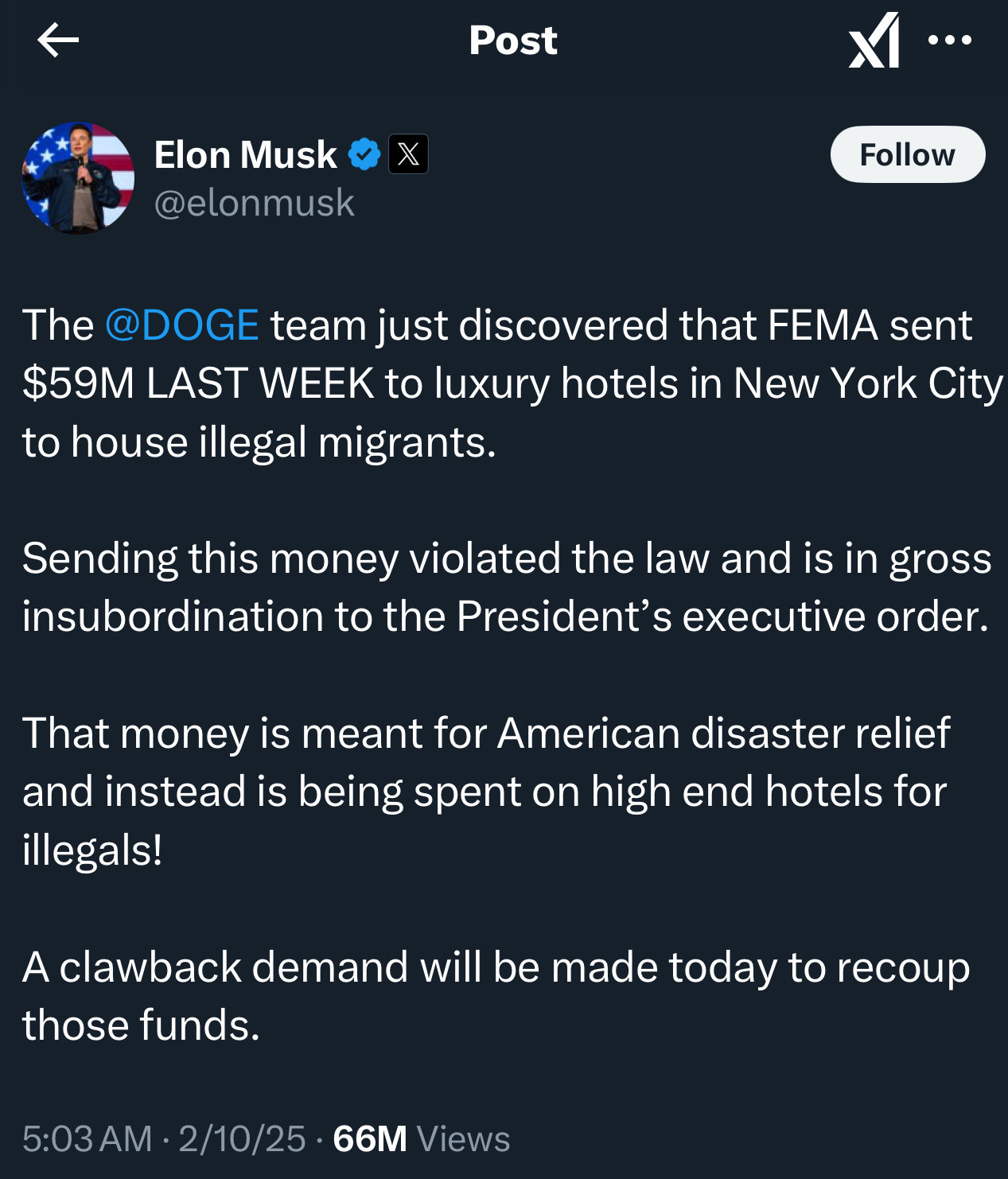
On Monday, Musk wrote in an X post that FEMA had sent millions of dollars to luxury hotels to house undocumented immigrants, fueling anti-immigrant sentiment.
“The @DOGE team just discovered that FEMA sent $59M LAST WEEK to luxury hotels in New York City to house illegal migrants. Sending this money violated the law and is in gross insubordination to the president’s executive order,” Musk wrote.
The following day, four FEMA employees were fired, and more than $80 million in federal grant money intended to help New York City shelter migrants was rescinded.
In response to DOGE’s ongoing actions, 14 states filed a lawsuit against Musk and Trump, accusing Musk of being a “designated agent of chaos” whose authority violates the U.S. Constitution.
“Musk’s seemingly limitless and unchecked power to strip the government of its workforce and eliminate entire departments with the stroke of a pen, or a click of a mouse, would have been shocking to those who won this country’s independence,” the lawsuit states.
The suit, filed Thursday in Washington, D.C., is led by New Mexico Attorney General Raúl Torrez and argues that Trump, Musk, and DOGE have violated the Appointments Clause and the constitutional separation of powers.
A similar lawsuit was previously filed by employees of the United States Agency for International Development (USAID), also accusing Trump, Musk, and DOGE of violating the Appointments Clause and separation of powers.
Meanwhile, a federal judge ruled Friday night that DOGE can continue to access sensitive records from the Department of Labor, Department of Health and Human Services, and the Consumer Financial Protection Bureau. The ruling blocks a request by unions to prevent DOGE from accessing data from the three agencies.


Leave a Reply